Author: Sarah Wei

  • John Tung on curating SEA Focus and the artistic sentiments in the region now.

    John Tung on curating SEA Focus and the artistic sentiments in the region now.

    When John Tung talks about curating, he begins with a toolbox, a literal one. Fresh from the close of the 2026 edition of SEA Focus at ART SG, Tung has a get your hands dirty attitude to exhibiting. “We had a really strong response,” he says. “[feedback was] very positive from most of the visitors… I’m very happy with how it turned out.” Behind the fair’s success lies a philosophy of exhibition-making that is far removed from the glamorous stereotype of the jet-setting curator.

    “People imagine stylish outfits and opening nights,” he jokes. “But I’m a hands-on curator. Behind me right now are toolboxes and scaffolding. My hands are beaten up and I am wearing workwear.” For Tung, the word “curate” returns to its Latin root, curare — to care. “Are you a parent? If you have never changed a diaper, I’ve said, is my approach to curating… There’s blood and sweat behind them — hopefully not tears.”

    Read on for our full interview Q+A covering SEA Focus, ART SG, curating, and cultural capital in the region, expectations, and more.

    On SEA Focus moving into ART SG

    Sarah: Previously SEA Focus was in a separate location, and now it’s inside the fair. How did that change the way you curated the show? SEA Focus has often been described as more of a museum-like experience than a typical fair booth.

    John Tung: That museum-like quality has really been part of SEA Focus’s identity for many years, especially since it moved to Tanjong Pagar District Park about five or six years ago. SEA Focus is a curated platform, so the experience is always closer to going to a museum than visiting a typical art fair booth.

    I’ve had the pleasure of creating three editions — two at Tanjong Pagar Distripark and this most recent one at ART SG. Each edition aims to create a very different visitor experience from the previous one.

    The approach stayed largely the same, but the venue made a difference. A convention hall is a tabula rasa — a blank slate. It gives you a lot of freedom to build walls exactly the way you want. In the previous venue, we had columns and architectural features we had to work around. Having a blank slate gives more opportunities to exercise creativity.

    For this edition, we centralised X-shaped walls, which became quite iconic, and in previous editions, we modelled the “islands” of the layout to resemble the archipelagos of Southeast Asia. A lot of effort goes into the selection of galleries and artists, considering geographic representation, gender representation, and where artists sit in terms of market presence. The experience is always carefully curated.

    Sarah: How do you think this curatorial platform helps bring in smaller galleries? 

    John: The galleries are actually a very diverse mix. They’re not necessarily all small galleries. Yes, you have new and emerging galleries, but you also have international powerhouses that have participated in numerous editions of SEA Focus as well.

    The unique thing about SEA Focus is that it’s an opportunity for artworks and artists to be contextualised among peers who are practicing in the region. Whether they’re established or emerging, they’re working within the same epoch. Their concerns are aligned; they’re living in the same zeitgeist.

    That’s the greatest value SEA Focus brings. Unlike a typical fair, where each gallery has its own objectives and commercial interests, here everything converges under a singular kind of territorial and conceptual banner. I think we’re starting to see that there is value in seeing connections and contextualising works, rather than just seeing them as individual commercial presentations.

    I thought it was really interesting that with the new Art Basel in Qatar [which opened from February 5–7, 2026], they’ve actually adopted a very similar approach — each booth is supposed to present one artist, they’re all thoroughly screened, and they’re expected to unite under that same singular banner. So this idea of having a curated experience — not purely a fair — we’re starting to see that there’s value in seeing the connections and contextualising the work as well.

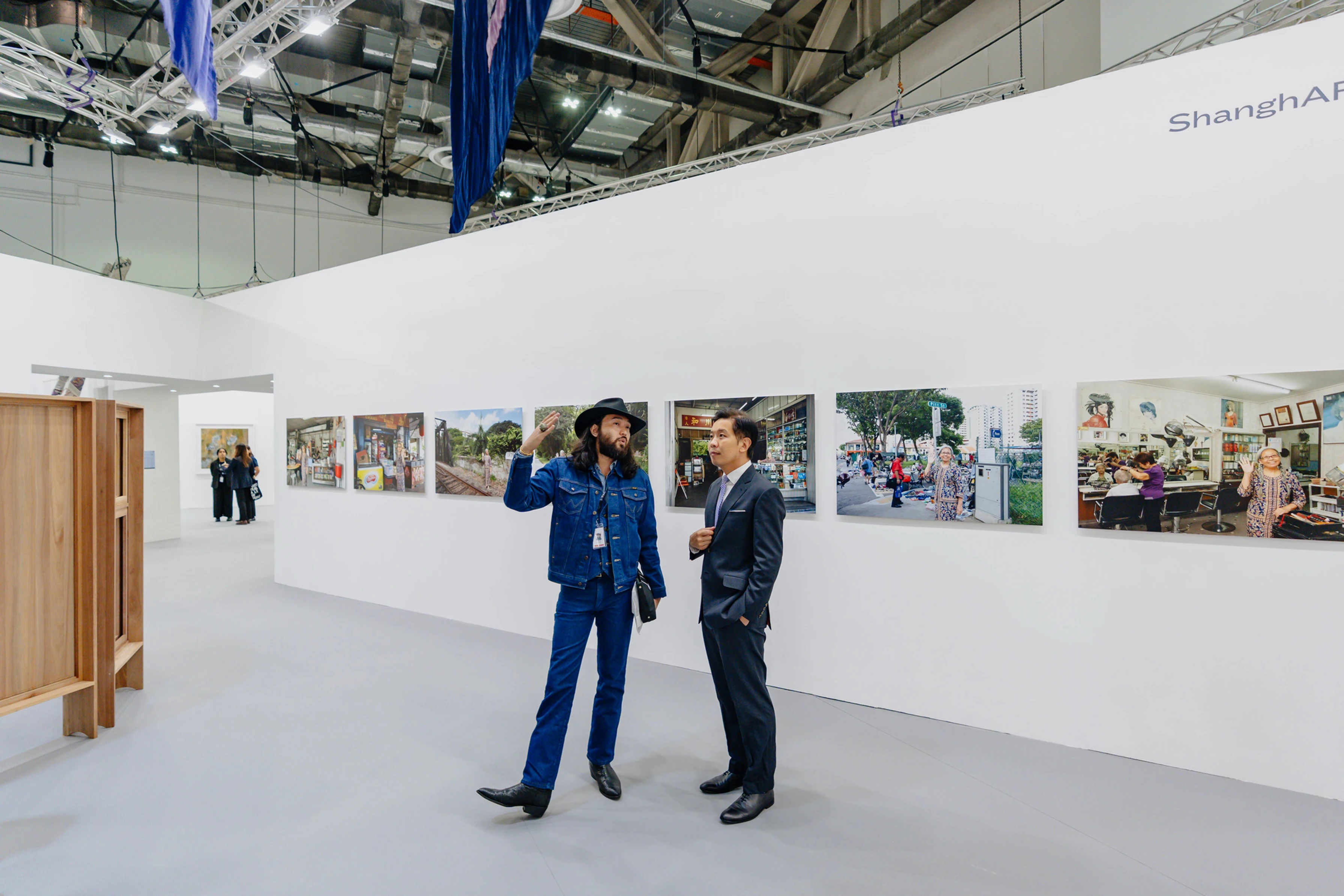
    Installation view of SEA Focus at ART SG 2026, Marina Bay Sands Singapore

    What collectors bought at SEA Focus and ART SG 2026

    Sarah: What were some of the most popular themes or works with collectors? Or even some surprise sleeper hits?

    John: [He jokes] I’m a horrible person to ask because I have got such a close working relationship in the realisation of the show. So every work always stands out to me as really unique and really special. 

    There was strong support for many of the young artists. Inez Katamso, for example, did very, very well, which shows collectors are very interested in a younger generation of artists.

    A group of young artists presented by Mr Lim’s Shop of Visual Treasures also saw almost all the works picked up by collectors. But then again, on the other end of the spectrum, a new installation by Robert Zhao was one of the first works acquired during the preview days. So, collector interest remains very broad in Singapore. People are looking at works across a great variety of price points, and SEA Focus is able to provide that range, from recent graduates and newly emerging artists to very established historical figures.

    Cultural capital in Singapore, the region, and the artist sentiments behind it

    Sarah: Do you think Southeast Asian artists are under pressure to explain their region to the world?

    John: I wouldn’t put it as pressure, but there is definitely awareness of how the international art world wants to frame Southeast Asia, and sometimes there’s active resistance against that. [On the platform Something Curated] I wrote an article recently about this notion of Southeast Asia being “up-and-coming.” Up-and-coming benchmarked against what? Are we talking about sales, infrastructure? Western models are still predominant in those conversations.

    Art doesn’t operate like Keynesian economics. In that regard, I think Southeast Asia remains very, very true to themselves. It provides a supply for a demand that doesn’t exist yet. Southeast Asian artists remain very true to themselves. They respond to issues they’ve engaged with for a long time, drawing on distinct and hybridised histories. There’s still very strong cognisance of the postcolonial nature of Southeast Asia’s existence, and that manifests quite clearly in the work.

    Sarah: Singapore is positioning itself as a regional cultural capital — what does Singapore enable that other cities don’t, and why? 

    John: My academic background is not in curating — it’s in cultural policy. I wrote my master’s thesis on the evolution of Singapore’s cultural policy. The notion of being a cultural capital is not new, and Singapore’s model draws from quite a variety of global sources.Even the United States’ Cold War policies come to mind, with the CIA funding abstract expressionist exhibitions abroad as a means of soft power. Singapore isn’t at war with anyone, but there is definitely a desire to be seen as a gateway to Southeast Asia.

    SEA Focus allows people to see some of the best and most recent offerings from across the region in one destination, instead of flying to eleven different countries, to tease it out, to do the excavation, bit by bit. Singapore is leveraging on a lot of its strengths, its history of strong bilateral ties with our neighbours in the region, and the confidence that our neighbours have in Singapore to be able to accurately represent and reflect the variety of tastes, beliefs, and opinions of the different peoples of Southeast Asia.

    That being said, I think it’s also a really heavy burden to bear, the burden of representation, right? So I think, for Singapore, as a commissioner for many of these events, the best they can do is find individuals who take this sort of responsibility seriously. And I would like to think I take this responsibility seriously.

    The growth of private museums in Southeast Asia

    Sarah: Shifting to the art scenes more broadly. How do you think the art scenes in other major Southeast Asian cities are changing?

    John: Across Southeast Asia, particularly in the more developed cultural production centres like Jakarta, Bangkok, and Kuala Lumpur, we’re seeing a rise in private museums being opened. MAIIAM opened fairly recently in Bangkok, and there’s MACAN in Jakarta.

    In Singapore, that trend isn’t manifesting at quite the same scale as in the region. Such as The Private Museum by the Teo Family. There’s also an influx of collector-established art spaces. So I do think that across the region, patrons and benefactors of the arts are really putting their resources where their mouths are, creating infrastructure that runs parallel to state-funded spaces. That’s helping to build a more diverse and vibrant ecosystem overall.

    Sarah: What do you think about collectors opening private museums?

    John: I recall the establishment of MAIIAM in Thailand, which is the project of a really notable collector, Eric Bunnag Booth. His rationale for establishing MAIIAM was quite straightforward. At that point in time, there wasn’t a permanent collection-based institution or museum in Thailand showing Thai art. He very much wanted Thai people — young artists, young students — to have the opportunity to see iconic works of Thai art in Thailand itself.

    Singapore was the regional powerhouse in collecting at the time, but he wanted a place where local countrymen could encounter their own art history. I wholeheartedly believe in the purity of his intentions and vision in establishing MAIIAM, and I think MAIIAM has really been a beacon in the region for how a private museum can be established, run, and operated.

    The space I am currently associated with, Project Art Hunter, was established by another notable Singaporean collector, Yeap Lam Yang. It’s nowhere near the scale of MAIIAM — it’s a relatively small space, about 1,600 square feet. Over the next couple of years, he plans to present a series of rotating exhibitions drawn from his own collection. At the same time, he’s also a well-known patron of the National Gallery Singapore and the Singapore Art Museum, having donated more than 100 works to these institutions. 

    But we need to be cognisant that not all works in a private collection fit well into an institutional context. Collecting institutions have their own acquisition strategies. Just because a collector wants to donate a work doesn’t mean the museum will accept it, if it doesn’t align with their particular strategy. So that leaves many works residing in private collections with limited avenues for public presentation, unless collectors establish their own spaces.

    For a private collector, their strategy does not have to align with institutional goals. They don’t need to chronicle art history in a structured way. Ultimately, private collections reflect tastes and sensibilities. As much as we want to prioritise academic research and art historical frameworks, we shouldn’t forget that one of the biggest catalysts for the development of art over the last 600 years has been connoisseurship. That is what private collections represent. Being able to see and experience the works and collecting preferences of these individuals is valuable. Not just for people who can afford to collect, but also for those who haven’t started collecting or cannot afford to collect as well.

    Quick Fire: The reality of curating, how and why, and what’s next for John

    Sarah: What do you think is one of the most misunderstood things about curating — and the part that’s not glamorous at all?

    John: If you just Google “typical curator,” even myself, right, it’s someone in a funky outfit or a business suit, looking glamorous at an opening. But there are many different types of curators, and I’m very much a “get my hands dirty” kind of curator.

    I’m a strong believer that curatorship comes from the Latin word curare, which means “to care.” And care manifests in many ways. Are you a parent? If you have never changed a diaper, I’ve said, is my approach to curating. What doesn’t get captured in press photos — outside of the fancy outfits — is that there’s a lot of blood and sweat, hopefully not tears, that go into the execution of an exhibition. My hands are literally the most beat-up things in the world right now after Singapore Art Week. It’s going to take a while to recover. But it’s the dirty side of the job that I think makes me love it the most.

    John Tung at SEA Focus 2026

    Sarah: What do you want visitors to feel as they leave one of your shows? What questions do you hope they walk away with?

    John: I think sometimes curating today is seen as this very abstract, theoretical, almost sexy thing — exploring material sensibilities, territorial ideas, all these conceptual frameworks. But at the end of the day, I’m still quite old-fashioned in that sense.

    “With pretty much every exhibition I work on, I always ask myself: what is the moral of the story? What should a visitor be walking away feeling?”

    In its recent edition, SEA Focus, for example, looked at violence perpetrated against people, the ecological crisis, and displacement. I want people to think more deeply about how well we’ve been doing as stewards of this planet. And frankly, we’re doing horribly, as far as I’m concerned.

    So when people go into my exhibitions, I want them to think about the issues I’m raising, which I sometimes put quite explicitly in the curatorial statements. My approach to curating an exhibition is actually the delivery of policy, but in a democratic way. If we think of policy as a form of social engineering, the state might have legislation, schools might have rules, and you’re obliged to follow them. But with an exhibition, you can consider my propositions. You can decide whether you want to buy into that set of beliefs or not. To me, that’s a very democratic way of delivering policy.

    Sarah: And last question — what do you have coming up this year, and what are you most excited about?

    John: I am opening an exhibition tomorrow night called Homecoming. It’s the third edition of a suite of shows I do annually with a good artist friend of mine, Kim Whye Kee.

    For this upcoming edition, I am really excited because, beyond Kim himself, we have a collaborator who’s also presenting, Royston Tan, the acclaimed director of 881 and many prominent works in local cinema. For the first time in 14 years, he’ll be presenting a new video installation. It consists of documentary footage of 100 families in Singapore having dinner.

    So the exhibition is a rumination on home and the rituals of eating, families coming together at the dining table, and a deliberation on what the notion of home, or coming home, really means. That opens tomorrow night [7th February 2026]. 

    Follow curator John Tung and his upcoming exhibitions, including Homecoming and future projects with SEA Focus and Project Art Hunter, as he pushes conversations around Southeast Asian art, cultural policy, and exhibition-making across the region. 

    at johntung.com or @johnsavage.fromthewoods

    [All Images Courtesy of Sutton Communications]
  • A Second Chance at Impressionism: NGV’s French Impressionism Show

    A Second Chance at Impressionism: NGV’s French Impressionism Show

    The National Gallery of Victoria’s restaging of French Impressionism from the Museum of Fine Arts, Boston arrives with a sense of both elegance and excitement (6 Jun – 5 Oct 2025). Drawn from Boston’s renowned holdings, more than 100 paintings by Monet, Renoir, Degas, Pissarro, Manet, Cassatt, Morisot, Signac and Sisley bring to Melbourne audiences a movement whose radical brushwork, saturated colour and novel viewpoints changed the course of art.

    The 2025 presentation makes up for the pandemic‑curtailed 2021 run and also marks the 150th anniversary of the first Impressionist exhibition. It is part of the Melbourne Winter Masterpieces series—an annually anticipated blockbuster—but the curators have emphasised letters and journals to foreground the artists’ voices, hinting at a deeper engagement beyond spectacle.

    Immersive Design and Staging

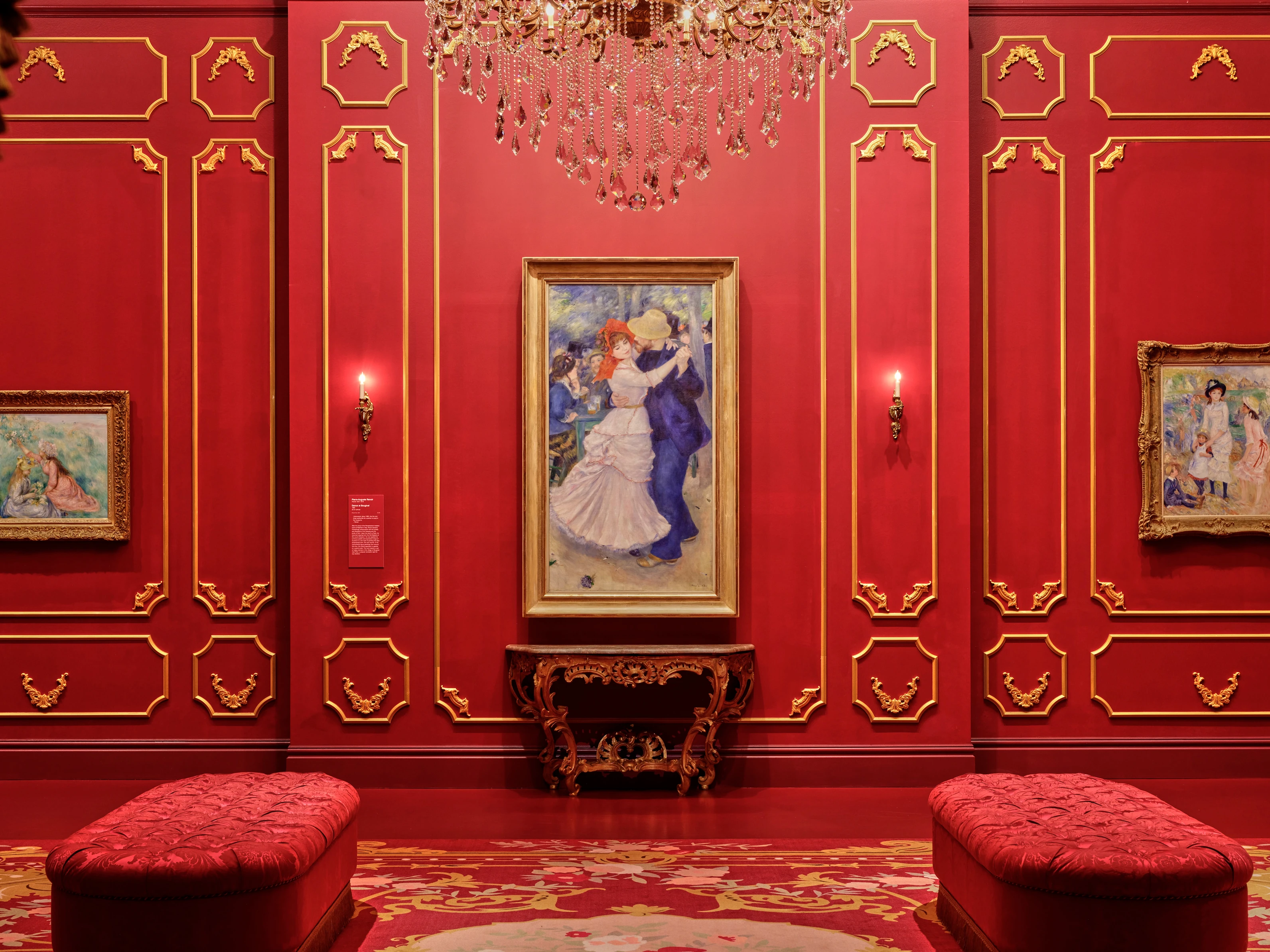
    Visitors enter through a long corridor dressed like a Bostonian drawing room, complete with parquet floors, columns and padded furniture; only two works—Renoir’s Woman with a Parasol and Small Child on a Sunlit Hillside and Monet’s Meadow with Poplars—hang on the walls. The scenography, inspired by East‑Coast collector mansions, situates the paintings within the period’s domestic elegance and hints at the American collectors whose taste shaped the MFA Boston’s holdings. Throughout the show, rooms shift mood: dark green damask for the Barbizon predecessors, duck‑egg stripes and lattice trim for watery gardens, embossed wallpaper and faux gaslight for urban realism, and opulent red‑and‑gold salons for Renoir’s experiments. It is a theatrical approach that immerses visitors in fin‑de‑siècle atmospheres while blurring the boundary between gallery and set.

    An entrance draped with luxurious green curtains leads into an elegantly designed gallery, showcasing a mirror and framed painting on the walls.

    Rhythm of Galleries and Highlights

    After the opening, more traditional hangs return, with thematic rooms dedicated to precursors, still life, urban scenes, and printmaking. A suite of Henri Fantin‑Latour’s roses, Cézanne’s fruit, and Berthe Morisot’s delicate needlework invites quiet contemplation, the next gallery dives into gritty cityscapes and Pissarro’s mentor‑and‑mentee relationships. The crescendo comes in a lilac‑white space filled with sixteen canvases by Claude Monet, including Water Lilies (1905) and Grainstack (Snow Effect) (1891), which demonstrate his obsession with changing light over decades. A final corridor of black‑and‑white photographic portraits of the artists and a projected film of Monet in his garden creates an intimate epilogue.

    A serene water lily pond depicted in soft colors, featuring floating lily pads and blossoms on a calm surface reflecting the sky.

    Highlights and Surprises

    • Self‑portrait by Victorine Meurent — A revelation in the exhibition, Meurent’s inclusion acknowledges her as an artist, not just Manet’s model. Her self‑portrait, with butter‑yellow silk and violet bow, asserts a confident painterly gaze and adds a feminist thread to the narrative.
    • Jean‑François Raffaëlli’s The Garlic Seller – This realist canvas of Paris’s outskirts brings working‑class grit into the show, reminding visitors that Impressionism intersected with social realism.
    • Degas’s Degas’s Father Listening to Lorenzo Pagans Playing the Guitar – Recently conserved, this double portrait emphasises domestic intimacy and sound, contrasting with Degas’s more familiar ballerinas.

    Get your tickets to the show here.

    National Gallery of Victoria / 180 St Kilda Road, Melbourne VIC 3004 / Daily 10am–5pm / enquiries@ngv.vic.gov.au / www.ngv.vic.gov.au

  • Bloodz Boi on his Debut Australian Tour, raw and unfiltered

    Bloodz Boi on his Debut Australian Tour, raw and unfiltered

    The Beijing rapper brought to Melbourne a deep-cut show of emotion.

    In the world of cloud rap, few artists carve out a niche as distinctively as Bloodz Boi. The rapper debuted on Australian shores and played two intimate shows in Melbourne and Sydney. He is known for his lyricism, lo-fi beats, and a stage presence that commands attention. The Melbourne show provided a raw, unfiltered look into his heart. We met up with the artist in tow, so read on as Yang Fan sheds light on his introspective approach to music and performance, and a desire for authenticity over fame.

    Sarah Wei: Is this your first time in Australia?

    Bloodz Boi: Yeah, first time. 

    SW:What do you think motivates your music?

    My life, yeah, I think my life. Right now, it’s mostly from my life, and maybe just art in general influences me. As soon as I start fighting with my mind… It’s not a very serious thing.

    SW:Is it the same when you create a set for a performance?

    I don’t perform a lot. I don’t want people to see me because every time I perform, I have to reface every scene I created from my songs. 

    My music and songs are careful and are not from good memories. So, while singing them, I want to make them very legit, make myself be there, make myself very sad or something, to feel that. I want to give the people 100% of what I am thinking. It is the emotions that are way more important than anything else.

    It’s like revisiting your emotions… Once you make a song or once it goes out to the public, do you ever revisit it?

    No, I don’t listen to my music. I have taken down a lot of music. The feeling is right now. I always change.

    SW: Why were you drawn to cloud rap?

    Because I’m a soft person. I don’t have a hard style; I am living myself. I don’t like the high energy. 

    SW: And what about DJing? Do you still do that?

    DJ for radio is good enough [currently Bloodz Boi hosts for NTS Radio]. I don’t like to DJ offline. 

    You don’t enjoy it as much?

    Yes. Sometimes, I will. DJing is like karaoke to me. I am saying, you can’t go to karaoke every week, or you will lose your passion. I listen to a lot of music, so I like to listen to it on a club monitor.

    SW: Do you feel much impact from the nightlife in Beijing?

    Like before 2019. When Dada [a Beijing club] opened, the first day I was there. The very old, the old one. I was in high school at that time. My music was influenced a lot.

    SW: Did you find a sense of community there?

    Yes. I made a lot of friends in Dada. I have a very good friend in high school, we grew up to grow up together. I’m older than him, and after his final high school exams in China, I brought him there the same day. Now, he DJs there, every weekend, there or someplace else in Beijing. I have met a lot of interesting people, but I have lost them in the last four years because I don’t talk to people.

    SW: Would you want to reconnect with them?

    I don’t want to be here in any community now, I don’t want to socialise. I only have one or two friends in Beijing. My very close friends don’t listen to my music, they’re not about the music. Never listen to my music, please. Like, I want people to know me. So, my real name is Yang Fan, I want people to know me.

    On the internet, it’s really interesting. Like people, if they saw you making music, they saw you as an artist, and then saw your listing. They think you are very famous.

    When people see you making music, they recognise you as an artist and then notice your fame. But the truth is, anyone can make music these days, much like anyone can send an email. But why? Oh, [because you] got to do something, you know? So, there are not many people making music like ours. I don’t want to trade myself.

    SW: How about China’s underground music scene?

    If you are an underground artist, you are an underground artist; there is no crossover into the mainstream. If you are commercial, you are getting big. Rich and poor. There is no crossover.

    SW: Is your collaboration mostly from your online friends?

    From different countries, talking different languages. Music is not about the language or anything else. So it’s really good. We can meet through the music.

    SW: Is there any artist you really want to work with?

    I want everything just natural. You know? For some people I make music with, it wasn’t because I like their music; it was just because I like this guy. And it’s way more than music.

    Like, I am a fanboy of some people as well. But I don’t want to break the feeling. I just want to listen to them, I don’t want to make music with them.

    If we make music, I want it to be natural. We meet, get to know each other, and then make the music.

    SW: Then, does each new track become individual to the artist?

    Yes, right, right. I never make a song where it’s just half a song, and here you go, do the rest. No, I won’t do that. Every song is just for him or for her.

    SW: How much of your identity do you tie to your music?

    Yes, all of them. I mean, I want the people to like me, for me. The music is a part of me. In the music, I can express all of myself. It is more than the music. It is the real me. There are some people who tell me it’s too real. Like this is too much. They can’t take it. This is too heavy… Like last night [at the concert], I tried my best. But the set up was not good, and it might have made people misunderstand.

    [At his Melbourne show, Bloodz Boi reperformed songs multiple times]. 

    Some people really come for me. I have to do that. I have to do that for them. I want them to feel, to listen, to my set and receive the vibe.

    Find Bloodz Boi’s music, tours, and radio shows here.

    Live Concert Images Courtesy of Valerie Joy.

  • Kelela + serpentwithfeet deliver a R&B show at Melbourne’s Now or Never Festival

    Kelela + serpentwithfeet deliver a R&B show at Melbourne’s Now or Never Festival

    After a three-year absence, Kelela’s return to Melbourne graced the Royal Exhibition Building with her soulful prowess at the inaugural Now or Never Festival.

    Opening the night were the captivating performances by Serpentwithfeet and local DJ MIRASIA. On a Sunday evening in August, this Melbourne concert became an immersive journey into the realms of R&B and an experiment in music production.

    The Festival’s musical lineup was a thoughtful, curated blend of complementary R&B styles. From the avant-garde sounds of serpentwithfeet to the artistry of Kelela and the dynamic mixes of MIRASIA, the audience was in for a genre-defying experience. Under the soaring arches of the venue, a diverse and eclectic crowd gathered, comprising dedicated Kelela enthusiasts, local artists, and fashion-forward youth. The ambience was further enhanced by a mesmerizing floor-to-ceiling LED screen backdrop for the deconstructed club music to come.

    MIRASIA DJ sets transitioned through the awkward silence between performers. Her performance was amplified by an ensemble of ballroom dancers against a backdrop of vivid red, pink, and blue lights. At times, the music ventured into exhilarating yet slightly chaotic electronic mixes that echoed with crowd favourites. Followed by serpentwithfeet, who took the audience through intimate sound bites and emotionally charged adlib monologues. The performance felt like a personal conversation with the crowd, drawing them in with his raw energy. Leaving everyone in anticipation of what was to come.

    serpentwithfeet in Melbourne. Photo Courtesy of Now or Never.
    serpentwithfeet in Melbourne. Photo Courtesy of Now or Never.

    When it was time for Kelela to perform, lights, claps, and puffs of smoke, a journey through her illustrious discography unfolded. She seamlessly moved through remixes, edits, and tracks from her earlier works like ‘Cut 4 Me’ to her latest album, ‘Raven.’ Kelela’s sparkling look captured angelic stage moments. The intimate lighting brought the audience closer to her and, coupled with the reverberating bass filling the hall, added a magical touch to the atmosphere. Other moments in the show ranged from slow renditions to electrifying dance parties to let the audience find their own connections.

    With her latest album, ‘Raven,’ exploring vulnerability, ambient techno, and release. She seamlessly navigated between minimalist club beats and celestial R&B. After a period of relative silence on social media, Kelela expressed gratitude to her dedicated fans for their unwavering support, dubbing it an “act of self-care.” As a respite from the usual club and techno mixes that dominate Melbourne’s nightlife scene. This authenticity was felt throughout her performance, reflecting the depth and versatility of Kelela’s artistry. As the night unfolded, the audience got lost in Kelela’s seductive music alongside an innovative soundscape for soul-releasing dance.

    Find out more about Now Or Never here.

  • Summer Stays, Italy from Coast to Country

    Summer Stays, Italy from Coast to Country

    From alpine mountains in Lake Como, Tuscan towns, historical haunts in Venice to fashion capital Milan, there is a lot to be envied. With a culture dating back thousands of years, the country strikes a balance between tradition and contemporary living. With everything to offer, read on for our top boutique and luxury stays.

    STAY

    A scenic view of a meadow with two cows grazing, surrounded by trees and rolling hills under a partly cloudy sky.
    Agriturismo Le Radici, Lake Como (Image Courtesy of Sarah Wei)

    Agriturismo Le Radici, Lake Como

    A secluded farmhouse behind Lake Como, is a must stay for locally owned and operated artisanal adventures just a short ride from the buzz of Milan. The countryside abode sits among the mountains, with access to the property only via Jeep pick up from the team or a thirty minute hike from the town of San Fedele Intelvi. The farm produces nearly one hundred percent of its own produce from vino, cheese, pasta to polenta, honey and fruit. The cured meats are hunted from the wild boar native to the area, as for the other wildlife you’ll find them walking freely across the grasslands from llamas, sheep, cows to horses imported from the owners hometown in Sardinia. Run by a humble couple, one from the local area of Como and the other Sardinia are conscious about the environment and continually looking for sustainable ways to run their small-scale operation. While adding their own taste of fusion to each dish — music bread or ravioli — pulling from a seasonal menu. With snow capped mountains in the Winter or lush Summer gardens this place is a fairy tale in nature.

    Agriturismo Le Radici / Alpe di Blessagno, 22028 Blessagno – Valle Intelvi, Como, Italy / +39 347 7403132 / info@leradiciagriturismo.it / leradiciagriturismo.it

    Locanda al Colle, Tuscany

    A spacious, elegantly designed bedroom featuring a large bed with white linens and a decorative headboard. The room includes two armchairs, a modern sofa, and large windows providing a scenic view of greenery outside.

    Soaking up Italy’s finest wines, while enjoying the Tuscan beachside, Locanada al colle is a panoramic guest house in the hills of Versilia. Situated an hour’s drive from Pisa, and less to Lucca, you can even take a trip to the ancient Estruscian city of Volterra. Hugging beach and vineyards, the twelve room stay is pet friendly and includes three suites, a salt water pool and jacuzzi. Plus access to a private beach club, Bagno Chimera in Marina di Pietrasanta. With vintage art deco and marble sculptures, each room feels dusted in warm, olive and creme colors that reflect the natural surroundings it sits in. While a private chef serves up local produce from breakfast to dinner, or pop into a cooking class to get a taste of the region’s hearty cuisine. The gorgeous family run business is the romantic vision of Tuscany you’ve been looking for.

    Locanda al Colle / Via la Stretta, 231, loc. Capezzano Pianore, 55041 Camaiore, LU, Italy / +39 0584 915 195 / info@locandaalcolle.it / locandaalcolle.com

    Aman, Venice

    A grand historic building along a canal in Venice, featuring ornate architecture and lit windows during twilight. Gondolas are docked in front, reflecting the elegance of Venetian style.

    Go back in time to the palatial settings of the 16th-century Palazzo Papadopoli at Aman in Venice. The 24 room hotel is replete with spa, gym, library, private jetty and gardens, with suites offering views of the Grand Canal. A hidden gem in the historic building is their intimate spa that is a must for scrubs or massages that will bring you to Asia with fragrant scents, a soaking tub and treatments. Adorned with painted ceilings from 18th-century painter Tiepolo, silk walls and chandeliers from the lobby to the rooms, Rococo artworks are paired beautifully with the compteroary stylings of Jean-Michel Gathy. Rising from the sea this ancient city is a world not far from fantasy whether for its grand canals, Basilica, biennials, glassmaking or cicchetti.

    Aman / Palazzo Papadopoli, Calle Tiepolo 1364, 30125 VE, Italy / +39 041 2707333 / amanvenice.res@aman.com / aman.com/hotels/aman-venice

    Four Seasons, Milan

    19th Century, Vaulted Ceilings Arch Over Heated Pool in Four Seasons Milan (Image Courtesy of Four Seasons Milan)
    19th Century, Vaulted Ceilings Arch Over Heated Pool in Four Seasons Milan (Image Courtesy of Four Seasons Milan)

    With an underground spa and pool in the heart of Milano’s designer fashion district, the former 15th Century Convent has style from heel to Murano chandelier. Spread across three interconnected buildings the 118 room hotel surrounds a central courtyard garden. Suites laced in marble, terracotta and earth tones balance well with the neighboring architecture and history, while contemporary touches bring a sense of peace next to Via Gesù. It’s the modern vision of Italy, from the Duomo, Galleria to Fashion Week.

    Four Seasons Hotel Milano / Via Gesù, 6-8, 20121 Milano MI, Italy / +39 02 77088 / fourseasons.com/milan

    A SMALL JEWEL

    Porto di Portoferraio, Isola d'Elba (Image Courtesy of Bjorn Agerbeek Unsplash)
    Porto di Portoferraio, Isola d’Elba (Image Courtesy of Bjorn Agerbeek Unsplash)

    Isola d’Elba, Tuscany

    With Tuscany’s manicured gardens, rustic vineyards and rolling hillsides, visions of Elba Island are for seaside lovers instead. Sun-soaked from coast to coast, Napoleon’s getaway is an hour ferry ride from the mainland, and is full of pebble-stoned beaches, yachts, boats and seafood luxury. Spiaggia di Pomonte and Relitto di Pomonte are for the snorkelers out there where a sunken ship just of the beach dwells beneath the surface, then the town of Capoliveri is a fortress of history that sits at the height of the eastside with views onto the sea.

    Isola d’Elba / Province of Livorno, Italy

  • Nick Harmer Artist Profile

    Nick Harmer Artist Profile

    Interview by Sarah Wei and Faye Bradley

    SEATTLE. Nick Harmer is an original member and the bassist for 25 Years with Alt-Rock Band Death Cab for Cutie. With nine studio albums under its belt since its debut in 1997, he reminds us that a love for music can withstand generations and the industrialization of the industry. The band which at this point needs little introduction came out of Bellingham, Washington starting from the college friendship and dorm rooms of lead singer Ben Gibbard and Harmer.

    A cultural canon for the Orange County surfers in California to suburban kids around the world, their most commercially successful album at the time, “Transatlanticism” in 2003 was a pioneer for the indie-rock sounds of the early 2000s. A backdrop to coming of age stories of first loves, breakups, and growing up.

    Harmer cites that even in his memories, music has acted as a tool to remember the different eras of his life: growing up in Seattle, Tokyo vinyl shopping, touring to crowds of twenty or thousands, and making it through Hollywood parties.

    Like many of us, music has played a key role in the evolution of our personal histories, and to quote Harmer, in a lot of ways, our music has kind of evolved with our age and our life experiences as we’ve moved along… Music has always been an extension of ourselves.”

    A band that has made it through the death of record stores, an era of college radio, high school mixtapes to now TikTok Top 40s, it is their value for good communication and authenticity that has held them together.

    “We all really value each other’s friendships and the time we spend together. We love going on adventures and playing music together. It’s our community.”

    When you think of friendship and the relationships we hold, you can relate to the lives of Harmer and Gibbard, sitting backstage after a concert putting on R.E.M. records, discussing their favorites of all time, and playing records together.

    “I can’t imagine spending my life doing that with anyone other than the other four guys in the band that I’m with…If that seems fun to you, then hang out with Death Cab for Cutie, because that’s what we do.”

    Even in the commercial success, to Harmer “the band is still very much intact from how it was in the very beginning”. Getting caught up in commercial success has not changed their creative process. Harmer tells us “the band started as Ben in a room recording a bunch of songs into a dictaphone by himself. And that’s the core of it from here until the end.”

    When breaking down the process, it starts top down – lyrics or samples from leader Ben Gibbard, before rifts and edits from Nick to the other members. “If he [Ben] never comes up with memorable lyrics or a melody that feels compelling, the song never goes anywhere.”

    As a band that came up in an era of touring – they’ve lived the Almost Famous life – with bus tours across America playing in front of crowds of 50 if they were lucky. The come-up to recognition has been slow and methodical for them, and in many ways how they ‘planned’ it. When it comes to the pressure, becoming recognized by the public, and performance aspects, Death Cab has always said, “You know what? It’s about the work, and it’s about the music.”

    For many bands in the 90s, the only way to make money was on tour. Today, bands start with an online following and miss the five-year start Death Cab had without cell phones. There is no chance to navigate, adjust and learn in the same way. To Harmer, this was a major advantage.

    “Each time we played, there’d be a few more people. It felt really manageable for us to have our career move in this slow crescendo… Even though only a few more people each time were showing up or buying our records, we were headed in some good direction.”

    To support emerging artists, Harmer hires from a crew of local people, brings local bands on national tours, and gives credit to new music. He says, ‘we want to share our knowledge… And [we are] always available for phone calls, talking to people about our experiences, and just trying to share the advice that we have earned over the years.”

    As Death Cab’s career has grown, fostering a ‘good and healthy’ music scene is key. This includes not only bands and musicians but graphic designers, photographers, and a pool of creatives to draw from.

    This article is from our artist profile feature on Nick Harmer available to read in print. Get your limited edition copy here.

  • Stories of Sea Rescue in the South of Europe

    Stories of Sea Rescue in the South of Europe

    TENERIFE. Sea rescue missions are a pinnacle humanitarian effort that continues today. Where rescue vessels, yachts, and boats carrying medical staff, doctors, psychologists, and some odd volunteers take to the bordering towns of Sicily, the Canary Islands, and Malta in search of tiny boats carrying refugees and migrants. Refugee boats leave North Africa in the hopes of being rescued, taken to safety and brought to a safer life on European shores.

    For many migrants, the struggle started in 2015 with civil unrest spreading across Syria and Libya. An estimated one million people have been suspected to have crossed the Central Mediterranean Sea by boat. Since the beginning of the global pandemic in 2020, the migrant boats are not slowing down, and as border controls tighten on the coast of Italy — sea routes, as they are known by local non-government organizations from the Med to Italy, Greece, and Spain have changed. Refugees are seeking asylum by crossing the waters of the Atlantic Ocean to Gran Canaria. A vastly more dangerous and unprotected route than before, with harsh weather conditions and pirates to add.

    The transit between the continents of Africa and the Middle East to Europe has always been a space for mobility and resettlement. In the past, many migrant boats would be fleeing from war, persecution, or conflict in their hometowns. The majority of refugees and migrants take off from the coasts of Libya, Turkey, Egypt, and Morocco — coming from the nations of Syria, Afghanistan, Eritrea, Somalia, and Nigeria. The major port destinations, in their eyes, are Valencia, Sicily, Malta, and the Canary Islands.

    We spoke to volunteers, Nathalie Suthor an investigative journalist and Thomas Nuding Managing Director of Search and Rescue for All Humans (SARAH) a non-profit sea rescue operations team and boat. The two have been on active missions to rescue refugees in both the Mediterranean and the Atlantic over the last five years. The main goal of SARAH is to build and run rescue boats, operate small medical clinics, and supply life vests to refugees.

    Ahkim 19 - SOS Mediterranee - 2018 - Mediterranean Sea
    Ahkim 19 – SOS Mediterranee – 2018 – Mediterranean Sea

    To create a new conversation between the many reporters, volunteers, and rescue groups we brought on Kenny Karpov, a contemporary photographer that documented the scenes from 2014-2019 as a way to report on the issues that have fallen out of the spotlight.

    In the following pages, Karpov photographs his volunteer experiences helping refugees at sea alongside snippets from our conversations with volunteers Suthor and Nuding.


    Thomas Nuding, Managing Director of Search and Rescue for All Humans (SARAH):

    “[Refugees] can only hope to be found by an aircraft or by another ship. It’s just a small wooden boat with one engine. Sometimes they have two engines, a bigger one, and a spare engine, but normally they only have one engine. If the engine breaks, they can only pray that they are found, otherwise, they will die.”

    Wooden boat - 400 + refugees - rescue - 2016
    Wooden boat – 400 + refugees – rescue – 2016

    “During the journey, different things can happen. In spring, the seawater can be at 13 to 15-celsius degrees, which is very cold. If people stay in the water for over one hour, they may get hypothermia. Also, if people stay on the boats without drinking water, their bodies can lose a massive amount of water. Moreover, some people who get seasick for very long times, will also lose a lot of water. People from the detention centers may also have knife wounds, gun wounds, psychological problems, and infectious diseases, especially COVID now.”

    “I can’t forget when there was a pregnant lady on a vessel who asked me to send her to the doctor. I can’t imagine how bad the situation in their country was, that this vessel was even safer than the land in their country. I think it’s a human necessity to help these people.”

    Ibrahim 17 - On board Topaz Respnder - MOAS - 2017 - Mediterranean Sea
    Ibrahim 17 – On board Topaz Respnder – MOAS – 2017 – Mediterranean Sea

    Natalie Suthor, Investigative Journalist:

    “[Rescue Boats] have seen people drowning in front of them or suffering from gun wounds. Refugees in bad situations, especially the women coming from the Libyan camps. When a person who lives in a civilized society knows about all of these problems, we want to help them. Therefore, the people at SARAH put a lot of effort into this small NGO.”

    “People are coming from everywhere in Africa. Sometimes we met a guy fleeing from Pakistan, trying to go to Europe. So they are from the whole world. People are moving to try to find a place where they can earn enough money to send it back to their family or just to start a better life.”

    late night celebration - Heading to Italy - SOS Mediterranee - 2017 - Mediterranean Sea
    late night celebration – Heading to Italy – SOS Mediterranee – 2017 – Mediterranean Sea

    This article is from our interview feature on Nathalie Suthor and Thomas Nuding available to read in print. Get your limited edition copy here.

    All images courtesy of Kenny Karpov.

  • Percussionist Angela Wai Nok Hui Experimental Music Artist in London

    Percussionist Angela Wai Nok Hui Experimental Music Artist in London

    Percussionist and multi-disciplinary artist Angela Wai Nok Hui, tells the narrative of her youth spent between Hong Kong and London through her collaborative project Let Me Tell You Something. Still relevant today, the show examines identity, relationships and memory through the performance medium.

    Paradigm Haus: How did you feel after Let Me Tell You Something?

    Angela Hui: I can tell you how I felt right after the show. Wing is my producer and we are good friends as well. She told me that she had a strange feeling but she didn’t know how to describe it. However, I didn’t feel that way because I have experience performing and I don’t get this kind of “post-show depression”.

    I’m using the show as a medium to express my feelings to the world and to Hong Kong, to London and to my family and friends. The show is me and I am a person that doesn’t know how to use words as you can tell maybe.

    Let Me Tell You Something, Image Courtesy of Angela Wai Nok Hui (by Dimitri Djuric)

    PH: I saw one of the photos where you picked a branch off the street, how did you choose different mediums and how are they all tied together?

    AH: I collaborated with different composers. The composer Gregory Emfietzis has a piece called “Hestia”, which means “goddess of fire”, “goddess of home” and “goddess of a home setting”. That piece is interesting because Greg made this card game with a set of instructions. I composed the whole piece with his instructions, so the composition is the input of that piece.

    For the main component, Greg tried to make me tell a story in front of the audience and he also told me it would be great to find any objects that are related to the story. I chose a full flowerpot and a baby’s glockenspiel, which is a toy instrument used throughout the whole program. This baby glockenspiel appears in Lucy’s piece and Jasmin’s pieces. Then there were normal bricking sticks, which I didn’t choose.

    PH: What does collaboration mean to your creative process?

    AH: Collaboration is very important for me. Collaborating with people is like talking to people. Because I am a classically trained percussionist. I went to the Royal College of Music. I spent six years playing a lot of notes, marimba, timpani, Beethoven, symphony, counting bars, triangles and all that. I love them. I enjoyed the experience. But then I always find it’s a little bit lonely when I’m practicing in my own practice room. I enjoy collaborating and making stuff in a whole different way that I wouldn’t even think of before asking people to join me, to have a jam.

    This whole project started more than two years ago. Two pieces for Angus Lee, a Hong Kong composer, are actually finished. The final version finished in 2019 with Timothy Cape, where I made a very weird dance next to a bass drum. He is based in Italy, he would have come to London to work with me if not for the pandemic. We were doing videos back and forth. We were looking for weird and different sounds and we were jamming. He was making projections for me to have a feel and then I told him my feeling. But then he would say “maybe that’s not how I want you to feel, so maybe let’s do something else.” I work with composers, so I need to trust that person and open my heart to them.

    With Jasmin’s piece, This Land is Yxxr Land, people could interpret the title of the piece differently. This piece is very personal. It was basically during an interview with me. She tried to record the interview and then put it into a new looping tape. It sounds not true at all, very emotional, but whenever I play that piece, I recall all of the memories that I told her. It makes me smile. Especially the first performance in Hong Kong, lots of friends and family came. I don’t know why the first performance is mostly for friends and family. Then the second is that of more colleagues.

    The first performance is the first piece of the show as well. I did not play the pre-show cassette, so I used this piece to bring people into my world and I try to use the cassette as a gateway for them to come in.

    So when I played that piece on the first night, it really was special because a lot of people that I’ve talked about in this piece were all there in the venue. It was creepy and it gave me goosebumps. That was a special moment, I didn’t expect that. Even one of my aunties bought tickets and came. She was in one of the events or one of the memories that I talked about.

    A close-up of a musical instrument with wooden bars, reflecting an abstract image of a person playing or interacting with the instrument, illuminated with warm lighting.

    PH: Then how do you think the audience affects your performance?

    AH: Comparing day one and day two, I would say performing in Hong Kong, in general, is different from what I normally do. In London, my family wouldn’t be there. If there’s a piece that I need to be naked, I could do that. But in Hong Kong, I can’t do that. Even though I can do that, I have to go through lots of mental preparation to do that. But I haven’t really thought about why I’m having that feeling.

    PH: Can you compare your experiences in Hong Kong to the scene in London where you’re normally based?

    AH: Not to say that London is having a good time as well. I think there is the same problem everywhere in the world. It is fine, we have to deal with problems that’s kind of our life.

    Audiences in London are more open minded and willing to support artists. I don’t know if that is the case because ticket prices are cheaper?

    In Hong Kong, I didn’t know that my show could be sold at $250HKD, which is expensive. The shows I went to in London were just around seven pounds to walk in. Early bird tickets were just five pounds. I would love to do an experiment on this, for example, what if I do a completely awful show and sell tickets for $10 in Hong Kong.

    In London, people are trying to bounce off ideas more openly. I’ve been in Hong Kong for two months, including my 21-day quarantine. I have a sense of the Hong Kong music industry, which is in groups. It’s very hard from the outside to break in.

    I think the observation for me, between Hong Kong and London, is that everything in Hong Kong is very, very pretty and well presented.

    For example, the big font of Tai Kwun is so pretty. All the wordings and even some English I don’t even understand like “microwave”. Emails used in Hong Kong are different from how we do in the UK. Whereas in the UK or in mainland Europe, such as Germany, Belgium, they have more of the rawness of art. I can see some really, unprepared, ugly, and raw shows in London, but then I don’t think I will get to see them in Hong Kong. But maybe ugly and beautiful really depend on how you see them.

    PH: Are there any kinds of trends that you’ve been noticing in experimental art or in the music scene?

    AH: People all have a lot of energy, but then they don’t have the support to do it. I’m seeing this crossing of disciplines, which might be a by-product of the pandemic.

    I’m a percussionist, I’m a musician and now I’m trying to do some sound and music design, which I would never have thought of before. So my by-product of the pandemic is five short movies I made for this show. People as artists are trying to see how far we could go in different directions, which is really good.

    Sometimes I don’t have the normal knowledge of how to make a sound and then something interesting can come out from that. I don’t know the normal steps of making a soundtrack. That could be the element of why the soundtrack could be so bad, or so good. So that’s why a painter tries to do music, and play percussion or piano. Simply because they don’t have normal lessons on how to do it, something interesting that I wouldn’t think of would come out of this.

    A person sitting in a chair with their head tilted back, illuminated by a lamp in a dimly lit room.

    PH: Do you think these thematic topics of the pandemic and cross-disciplinary avenues changed how artists approach their practise?

    AH: The pandemic didn’t really change what I wanted to talk about in the show. It was more about what happened in Hong Kong during these two years that changed a little bit on this show.

    For me, it all started by asking myself who I am. The identity crisis, you know? Where is home? Do I have one term or do I need to go back to my home? Am I humble or maybe I have no home and I will never have a home. And then the whole movement happened in Hong Kong.

    It makes me think no matter where I go, I really have a very strong bond with Hong Kong and that would never change. I think I found the answer or maybe I don’t think I would ever find it. Do I have one home or do I have no home? I could have two homes. Now I’m married to an Italian Frenchman, so here’s my home as well? But it doesn’t really matter, I think I’m just going to continue this journey.

    So I think that is a little change of direction because of what happened or what is still happening now in Hong Kong, such as people leaving the country and moving away. So I’m really excited about the London one as well. I really don’t know how the audience or Hong Kongers in London would take it. What would it remind them of? Can I give them the sweetness, a bit of comfort or would I remind them of something bad? So for Let Me Tell You Something, I didn’t really tell them forcefully and spoon-fed them. I created a space for them to tell themselves something. People would get different things from the show.


    Follow Angela Hui on Instagram here: @huiwainokk

    For more of Angela Wai Nok Hui’s work Let Me Tell You Something and her debut album.


    Let Me Tell You Something collaborators on Instagram:

    Lucy Landmore

    Timothy Cape

    Gregory Emfietzis

    Angus Lee

    Jasmin Kent Rodgman

    All images courtesy of the artist.

  • BOMS a Graffiti Artist in Hong Kong from Anime, Cartoons to Social advocacy.

    BOMS a Graffiti Artist in Hong Kong from Anime, Cartoons to Social advocacy.

    Hong Kong-based street artist and b-boy BOMS, speaks on his growth as a creative individual and the influence that street dancing and hip hop have on his art pieces. Sharing his thoughts on modern-day graffiti art, he explains how COVID-19 and the Hong Kong movement has had an impact on the art scene.


    Paradigm Haus: I heard you started as a truck driver, how did that lead on from then going into graffiti and street art?

    Boms: Well, actually I was not the driver though. I didn’t even have my driving license. I was just an assistant to the truck driver. So the truck driver is like a team leader to me. I’m just a little boy working with him. We need to carry on a bunch of silver and then deliver it to different doors.

    After I resigned from my nine to five full-time job, I was just seeking my bread and butter, and then I took in a lot of different types of stuff, like a delivery boy and even a painter just to put my foot on the table. I was fascinated by the truck driver, like all those road rages and maybe some clients made him super angry while he was driving on the road.

    The truck to me, it’s like traditional graffiti. For graffiti, there are some trains running around New York City, but in Hong Kong, it’s so hard to get inside the train station to paint all the trains. So a truck will become the train in Hong Kong. They drive around the city. We paint on the truck and it runs. That’s pretty fascinating to me. So for my artwork, I also projected some kind of experience with the trucks. So I’m a truck man, I love to paint and I also worked inside. It’s pretty close to me, I think.

    PH: How did you get started with b-boy and hip hop influences as well?

    B: After I graduated from high school, I went to IVE which is an education center. We have different kinds of subjects. I was in design because I have loved to paint since I was little. I started to get to know a lot of different societies and clubs. I went straight to the dancing scene because I love to listen to hip hop music, like Eminem and Linkin Park. I liked the music, so I wanted to get involved with the music, but I don’t have the ability to play instruments. I thought why don’t I just move my body around? So I got into the dancing society, doing choreography, being a b-boy and going inside the hip hop culture.

    PH: How does that work? Does it ever intersect in terms of your dancing and being kind of like a multidisciplinary artist? Do you see yourself in that sense?

    B: At the beginning, I think it’s like two separate things because I love dancing and I also love painting, but once I dig inside two different things, I started to realize that some things are similar. When I’m writing a word or painting a big word, we have a flow. We also have a flow when dancing. It’s like some water or liquid flowing around. I’m using the pen or I’m using my whole body to express that kind of flow. So those two things are pretty similar. It’s like I’m visualizing the rhythm.

    PH: Have you seen the dancing and the street art changing since you started?

    B: I think on the street art scene, like the graffiti, more and more people grab the spray and then go to the street. I think it’s because, after the movements in Hong Kong, people need some ways to express their emotions. I think using spray it’s a pretty nice medium to express ourselves. People start to know maybe they can grab their own spray and spread messages, whether it’s a name or some other message. More and more people are doing this, so I am feeling good about it.

    PH: What kind of groups and individuals are you seeing getting more involved in this scene? For example, are there any kinds of patterns that you’ve noticed?

    B: Anyone and everyone. Because you know graffiti is ghetto stuff, which came from the street, they don’t need to receive a lot of education to get to know that medium. I think it’s suitable for everybody.

    PH: It’s quite interesting because I think there’s quite a big contrast between Hong Kong. Some places are industrial, kind of underground, grimey, still like a developing city. While there’s also the finance sector and the high glam. Do you see it ever intersecting at all?

    B: I think we are in different categories, because most of the people who are doing the gallery stuff are more artsy, which is not a popular lifestyle. I think street art is pretty down-to-earth. But I am not really familiar with the gallery stuff, so I worked with that gallery team to explore more about it.

    PH: How do you categorize the lifestyle of street artists?

    B: The people surrounding me all have a similar background. They are all from the public houses and then go to the society and find a full-time job, but maybe the job is not the best for them, so they quit and started to do street art. For me, I would say it’s pretty down-to-earth. However, there are also some other artists from different backgrounds, such as being from a more wealthy family. I can’t represent all of them.

    PH: How does storytelling play into your artwork? I remember I saw some of your art with anime, Godzilla-like aesthetic with the Hong Kong skyline too.

    B: In recent years, I have been trying to explore my hometown. After the movement, I think what is more important for me is where I come from. I can show you this artwork from Arthur Hacker called Lap Sap Chung. This one is a rubbish worm, promoted by the Hong Kong government during the 1960s to 1990s and used as a city ambassador for city cleaning.

    I tried to develop these characters from past pop culture references. It’s different because for the early years, what I did was some original characters, some myths like Godzilla. Like you said. For example, there’s a fisherman in some old story and then I pick it up and design another character. I think that’s the biggest difference between my past artwork and what I did recently.

    PH: What caused that change? Why did you start choosing these new more Hong Kong-based characters?

    B: I think what makes Hong Kong Hong Kong is the age between 1980’s to 1990’s. So that’s why I try to travel back as if I have a time machine and then find some characters while Hong Kong is Hong Kong, then just make them pop out today.

    PH: Do you feel some nostalgia towards those 1980s and 1990s characters or the time in general? Also, why do you think Hong Kong was more Hong Kong-style back at that time?

    B: What people know about Hong Kong is that Hong Kong is a mixture of Western culture and Eastern culture. Many Westerners lived here and built a lot of Western-style architecture. So back to that time, the old Chinese architecture and new Western architecture all blended in this city. However, nowadays some historical Western architecture got torn down and replaced by skyscrapers. I can’t say it’s not Hong Kong but it’s what Hong Kong is like today. It’s an Eastern mindset that portrays the whole city landscape today.

    PH: Do you think that era was more authentic? How would you categorize today? Are people being real about what they’re trying to say? I guess because sometimes I feel people can create art in a way that they just want to cater to the XYZ audience or to a new market. But I feel with street art, there’s a lot to it. That’s more about what we feel and what the people feel.

    B: Yeah. I love the buildings in the past, because nobody can tell how Hong Kong will go in the future. I can just become a narrator and watch back, and then pick up something about Hong Kong stuff to portray in my art. But I think for today it’s pretty hard that you need to be brave to be real in the Eastern culture, especially after the movement. But before the movement, people didn’t really care about politics and society so they didn’t realize what was happening in the world.

    PH: Do you think street art is becoming better or worse?

    B: I think it’s like a battle between street artists and the government. The government forced us to do more street art! It’s nice that many of my friends I know are doing graffiti in other countries. When they come back to Hong Kong, they will say “Oh, Hong Kong is too peaceful. You’re pretty safe doing graffiti in Hong Kong, you can paint whatever you want”. But now, there are more and more people getting involved so you can’t be lazy. You need to go out to the street, maybe a couple of times a week and then get yourself up to date with the city. So yeah, I would say it’s a good thing.

    PH: It’s a good thing. There’s more rebellion out of everyone now.

    B: Yeah, graffiti came from the rebellion mindset. We can’t be good boys 24-7.

    PH: Do you think there is more opportunity for emerging artists to get known?

    B: I don’t care who is watching, but I believe the people outside are watching Hong Kong and what’s happening in the art scene. To me, the most important thing is just being real and being honest to yourself. Also, of course, be honest about your art. I don’t care about marketing, just about what I did in my art. It’s not very popular in the market, but I don’t want to twist my style because of any other comments. I started doing some business so that I can protect my little operation space, then I can keep doing what I want to do. All about achieving a balance.

    PH: Who do you think you’re inspired by in terms of your art?

    B: In technical terms, I’m watching Stefano Bloch from LA. I’m also watching Helio Bray and Sofles of course. They are all super well-known graffiti street artists. They have some unique skills. I really love their artwork. In Hong Kong, after I resigned from my job, I tried to do different stuff. I went into a company called Egg Shell Sticker. It’s a pretty well-known sticker company in the world. At that moment, the company was owned by my friend Dan, who is also an artist.

    I tried to learn from him because he is an experienced artist in Hong Kong. I got some inspiration from him. After I did it for two years, I found my partners doing my business and they also inspired me in a mental way. In the past, I didn’t really care what was happening around me. After I had my partners, I started to be aware of what was happening around me, which really changed a lot of my life and my artwork. So, I’m pretty grateful that I met all these guys.

    PH: What effect do you think it’s had on your artwork?

    B: I think it’s the message and the storytelling. Recently I’m not only focusing on some fantasy stories but some cultural stuff and some slang from my hometown. I turned them into my art. I keep creating a logo to represent my hometown in the way I think it should be, which is the main difference between what I did previously and now.

    PH: What do you think a logo should be?

    B: I think a logo should be a super expert on our language, Cantonese. As you did mention I mixed two languages, English and Cantonese in my art, this is a norm for every single Hong Konger here. For example, we have some English words like ‘shopping’ pronounced by the local Cantonese accent. It’s inside our culture. Therefore, I think Cantonese is definitely one of the ways to present who we are.

    PH: Outside of graffiti, do you think language as a medium is another one of your favorites?

    B: Yes. We will call ourselves writers because graffiti is mainly a writing thing and that’s definitely the medium. My mother tongue is Chinese, so I started to explore how to write Chinese for graffiti.

    PH: What do you value in terms of the art that you create? What message would you like to send?

    B: I think it’s basically every story that happens around me and also some cultural stuff, such as Cantonese. I wish I could make a guide for people about Cantonese because there are a lot of local slang with double meanings, which are super fun. I wish I could present the fun part of Cantonese.

    PH: Yeah. I feel whenever I learn Cantonese, it’s more about profanities. That’s fun.

    B: It’s so interesting. Last year I created some allegorical sayings in Cantonese. I turned the first part of the meaning into a piece of art, and I kept the second part to let people think about it and guess the story behind it.

    PH: I want to ask as well about the light trucks that you’re making, the sculptural works. Are you still working? What came first? When did you start getting into sculptural pieces?

    B: Actually it’s a toy project. My first exhibition was in 2017. The monster truck you saw was my original character. My friend visited my exhibition in 2017 and he invited me to make it into a sculpture. Then I gave him the design. Now the project’s hanging in the air. We originally planned the whole project to be launched in 2020, but the movement and COVID-19 made everything get postponed. We all wish to restart the project now.

    PH: Do you think your art changed a lot because of the movement?

    B: I think I focused more on the Cantonese stuff after the movement. As I said, I want to present Cantonese to the people, which is who we are, but I still love to paint a character.

    PH: What are you working on at the moment and what do you hope for? What will you be doing in the future?

    B: Recently, we opened a retail shop and I am working there. For my art, I have some projects with some galleries. We are collaborating with many artists, including tattoo artists and pop artists, to present a group show together. I want to keep doing the gallery work because I think it provides me with power. I also continue to paint when I’m hanging out with my friends.

    PH: Can you tell me more about your retail shop?

    B: This is one of my parts of the business. My friends were running different brands and products. Some of my artist friends may have made some artworks but they didn’t have a place to display and sell. Therefore, we opened a shop to let our friends put their brands, products or artworks at our shop.

    We also have some trendy stuff, such as Northface and Carhartt, so we can guide people to that trendy stuff. I am also doing some business importing cans, so I will put them at my store for styling. My artist friends can also find a place to show their work. We hope to have a space to build our community and stay united.

    PH: Are most of the products or artworks you’re showcasing in your retail store locally sourced?

    B: No, not only local, because one of our partners is actually from LA, he also brings some American brands and jewelry to our store.

    PH: That sounds really interesting. I’m excited to see it!


    Find BOMS on Instagram at @boms_boming_here

    Discover more on BOMS and his latest portfolio on bomsblackbook.com

  • Nina Las Vegas on Sydney’s Multicultural Music Scene

    Nina Las Vegas on Sydney’s Multicultural Music Scene

    Nina Las Vegas on creative social enterprising, multiculturalism and how it plays into Sydney’s music industry.

    Interview by Sarah Wei

    Paradigm Haus: Can you tell us about the first moment or memory you have that made you fall in love with music?

    Nina Las Vegas: Honestly, I can’t remember that ONE moment. It’s lots of moments over lots of years, including hearing the Kelis’ Kaleidoscope, DJing at Coachella, early Heaps Decent workshops, even a Ninajirachi & Kota Banks show I worked on last month! It’s in my blood at this point.

    PH: Take us through your creative process and inspirations.

    NLV: I’m driven by people, things and experiences around me. I document everything, keep a diary and scrapbook, use Pinterest religiously and listen to lots of music. I usually think about where I want a song to be played and go from there with a simple beat, sample or rough vocal hook.

    PH: How has multiculturalism played into Heaps Decent’s core values?

    NLV: Heaps Decent has always been committed to providing resources for all young people to express themselves and their identities, no matter who they are, their background or where they are from. One of the best things about Heaps Decent projects is that often people come together from vastly different cultures and experiences, to make music or maybe visual artwork. This is a really powerful and grassroots way to make space for inclusivity, shared knowledge and respect between individuals and the communities they live in.

    PH: In what ways does multiculturalism influence the music that you and your young artists create?

    NLV: I make dance music, which is clearly inspired from Black music and pioneers. I love learning about regional sounds, where they are from and how I can work with their makers and communities – so I can build my own sound around my understanding of the history. I think we need to learn where things come from before we can start creating!

    PH: What are the cornerstones themes and popular trends you see happening in Sydney and Australia for music right now?

    NLV: I think we’re all trying to survive through COVID! It’s a really hard time to be an artist anywhere in Australia, so it’s ok to pace and really dive into new ways to make & release music – as live shows are never guaranteed.

    Nina Las Vegas Boiler Room DJ Set by Boiler Room (via Youtube)

    PH: Why and in what ways is the music scene in Sydney different to other major cities such as London, New York or Seoul?

    NLV: Again! So hard to dive into through these Pandemic times. I think ultimately, Sydney has a much younger scene and it’s only just opening up and becoming more diverse.

    PH: How have you seen Sydney’s music scene change?

    NLV: Of course! West Sydney artists are taking over the airwaves and encouraging other communities to make, release and play music that showcases their identity. We are no longer a music landscape of indie, beach-side rockers!

    PH: What would you like to see come out of Sydney’s music scene?

    NLV: I would love to see more diversity behind the scenes. Managers, label teams, promoters coming from the community representing the community!

    PH: Tell us what you’re working on now and have coming up.

    NLV: It’s lots of label work (NLV Records) and not much touring! I’m also planning on returning to Wilcannia with Heaps Decent when COVID allows.

    Listen to Ninas latest release, Busy (BAYLI Remix) available on streaming services.

    Video: Busy (BAYLI Remix) by Nina Las Vegas. Provided to Youtube by NLV Records 2021. Released on: Jan 21st, 2021 Produced by: Nina Las Vegas, BAYLI & Swick Written by: Nina Las Vegas & Bayli Mixed by: Swick Mastered by: Joker


    Follow Nina on Instagram at @ninalasvegas and her non-profit music education group @heapsdecent.

    All images courtesy of Nina Las Vegas and Tayla Martin.