Category: Interview

  • Nathalie Suthor on Her Sea Rescue Journey Through the Mediterranean

    Nathalie Suthor on Her Sea Rescue Journey Through the Mediterranean

    Nathalie Suthor, an investigative journalist from Germany who set off on her first sea rescue mission in 2016, and here is the impact five years later.

    Interview by Sarah Wei and Faye Bradley.

    This is the uncut conversation from our feature on ‘Sea Rescue in the South of Europe’ coming out 2022 in print.


    Paradigm Haus: What has your experience been so far covering the refugee crisis and what have you learned?

    Nathalie Suthor: It was 2016 when a lot of people tried to reach Europe on boats crossing the Mediterranean Sea. The refugee crisis was in every newspaper, which was a big topic. There was also a heated discussion in Germany. Some people were concerned that there were too many refugees, while others said we should help the refugees instead of watching them die. Many NGOs were founded during that time and went into the Mediterranean sea to rescue the people.

    I joined in 2017 on one mission— the NGO was Jugend Rettetand and the boat was called Iuventa. The boat usually started in Malta and traveled close to the Libyan coastline, where they patrolled. We were there all the time to look for refugee boats that were usually small wooden boats or inflated rubber boats. It was traumatic for me, especially as a mother, because after staying there for about a week, we suddenly found some boats carrying mothers and their young children on the Mediterranean sea. It was unbelievable for me when I realized how dangerous the Mediterranean sea could be. I wondered how tough the situation was for people who went on a boat with their children and tried to reach a better life.

    Those NGOs had been working there for one and a half years. Mostly they would go abroad to Italy since most of the refugees came from Turkey to Greece and then crossed the Mediterranean sea to Italy. However, it also caused a European problem that many European countries regarded the problem was only for Italy rather than themselves. There are many refugee camps in Italy now that are a severe problem, but other European countries don’t care or try to find a solution for it.

    Additionally, Europe made a deal with Libya that they paid the coast guard money to let them stop the rescue boats to leave Libya. Right now, the situation on the Libyan coast is in big trouble because the Libyan coast guards try to block NGOs to rescue the refugees’ boats. Italy also gave a pushback. They tried to use some reasons to not allow the boats to leave the harbor, such as too many life vests.

    Many people in Europe also discussed the reasons for the rising refugee crisis, which was in my documentary as well. There were some political and historical reasons about how Europe treated Africa in the past to make them have nothing now, so people tried to search for a better life somewhere else. There were also wars between warlords in their countries. The traffickers made money by bringing the people on the boats to Europe. However, when the refugees arrived in Europe, they would be stuck in camps and have no chance to start a better life. Europe hasn’t released a solution because other countries think Germany and Netherlands took too many refugees. The situation is very bad now.

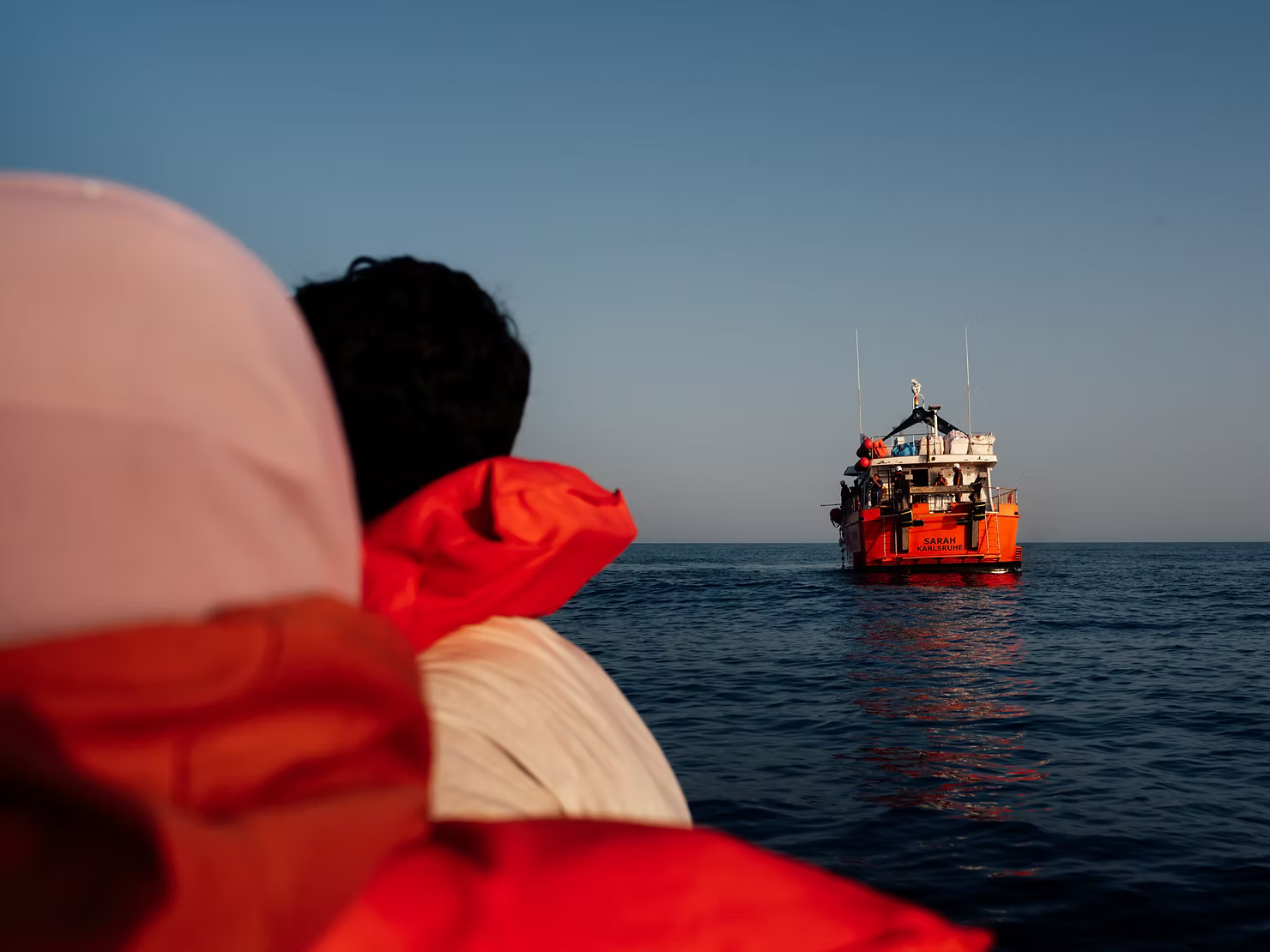
    Image Courtesy of SARAH Seenotrettung

    Now, some refugees are trying to take the new route to reach the Canary Islands, which started in autumn last year. They also tried to reach Europe through this route in the past, but it was extremely dangerous and difficult. Refugees could use small wooden boats on the Atlantic Ocean to travel to those small islands from Africa, which was time-consuming. Once, we found hundreds of people were stuck on a boat for a week. They wouldn’t know what would happen. Water, food, and fuel might not be enough. Therefore, that was the reason why I joined the second mission, where I met Riley. We tried to find out about the route, who those people were, and where they came from, and so on.

    PH: Where were most of these routes going through in the Mediterranean?

    NS: Yes, the first route was across Turkey to Greece, but Europe agreed with Turkey to stop this route. Then, people tried to cross the Mediterranean. Mostly, they left from Libya, where there were many NGOs that were always crossing the Libyan coast. However, afterwards, a big discussion came up about the push and pull factors in Germany and Europe. The traffickers found the NGO boats and they made refugees know the NGOs would take them to Europe, so more and more people came because they thought it was a safe way to go. That’s one of the reasons why the European countries tried to stop the boats.

    In the first documentary, we were arrested by the Italian government because they said our boat had something wrong. We had to go back to Lampedusa. Then the policemen came on the boat at the Lampedusa port and they thought we made a deal with traffickers, which was quite funny because there was a TV crew on the boat making a documentary for a major public German television like the BBC in the UK. Of course, the police didn’t have the proof, so we could leave. However, after this mission, the police arrested some people from NGOs and kept the boats in Sicily. The boats couldn’t leave anymore. Right now, there’s a trial going on. 10 of the full-time NGO workers are facing 20 years of jail because they were regarded as traffickers. That’s the situation now.

    PH: For smaller NGOs, such as SARAH, how do you face those challenges?

    NS: SARAH is a newly founded one. I met the founder three years ago in my town. People at SARAH work tightly together and always talk to each other because we have the same goal. NGO workers are shocked to see a small wooden boat full of refugees. They have seen people drowning in front of them or suffering from gun wounds. Refugees were in bad situations, especially the women coming from the Libyan camps who were all being raped. When a person who lives in a civilized society knows about all of these problems, we will want to help them. Therefore, the people at SARAH put a lot of effort into this small NGO.

    PH: How would you prepare for these missions in general?

    NS: Normally the big NGOs have support from a trauma expert. They will come to talk to you before you go on the mission. It was quite interesting for me that I thought I could handle those traumas since I made some documentaries about these tough topics, but it did affect me a lot some years later. I made a documentary three years ago. When I watch it at midnight, I feel touched and depressed.

    The documentary shows that we looked for a disappearing boat for the whole night. On the next day, we found it and many corpses were floating on the sea. There were around 200 people on that boat. A couple of months later, I went to Tunisia to visit a fisherman. Because of the currents and the waves, a lot of corpses were taken to the beach. The fisherman buried them and built up a grave, as well as told me the stories about these people. For example, a woman tightly hugged the child to not lose the child.

    Rescue operation at night involving crew members and a lifeboat from the Guardia Costiera.
    Image Courtesy of SARAH Seenotrettung

    PH: How did your missions for the documentary in 2016 and research come about?

    NS: I met Thomas, the founder of SARAH, in my town in 2017. He told me that they founded an NGO and they were going on a mission to the Canary Islands. In Germany, the TV channels were not keen on these topics. After my documentary in 2017 was broadcasted, someone attacked me personally on Facebook saying I created problems in their lives and brought all the refugees to our country. Therefore, when Thomas told me, I decided to join him with my cameramen.

    The documentary will be broadcasted next month. Not so many dramatic things happen in this documentary, but it’s quite interesting to see how the new route is working. We found out refugees were leaving from Morocco. They went from the Spanish coastguard to Gran Canaria. There were refugee camps but some were closed. The government gave the refugees COVID tests and brought them into hotels or military camps. There was a demonstration when we were there, because in Lesbos or Moria, Greece, there were very big refugee camps. Although some people in Greece thought they should have helped the refugees, they still worried tourists wouldn’t come anymore because of the big refugee camps. It was a little weird when people were lying on the beach, a refugee boat arrived. In Gran Canaria, people were afraid that it would be the second Moria or Lesbos and the tourist industry might be affected.

    PH: Do you think documentaries are helping in opening people’s minds?

    NS: It’s what I’m always hoping for, but sometimes people will blame you because they think refugees shouldn’t come and that’s not their problem. I always hope I can change something in the minds of people.

    PH: You talked a lot about more people going to the Canary Islands. How did you find out this information?

    NS: NGOs are well connected in Africa. They know quite well what’s going on in Africa. For example, there’s an NGO called Alarm Phone that spreads its phone numbers in Africa. They told people to contact them when people were in trouble on the boat. There is staff on the phone in Europe 24 hours, seven days a week. When they get a phone call from people who are in danger, they will call the coast guard and the media. They’re well organized and always connected with the whole situation.

    PH: So the major route now would be to the Canary Islands? Is that only recently because of the pandemic?

    NS: No. There is a big fight for all the NGOs to go out on a mission with their boats because the Italian government always finds some reasons to block the boats. A lot of NGO boats got blocked at European harbors and can’t go out. Sometimes there’s no NGO, but only the Libyan coast guard brings the refugees back to Libya to the camps. When we rescued these boats, the refugees always asked where we would bring them to and begged us not to bring them back to Libya, because they thought those camps were the worst place. This route is a big problem now. People want to find a better life, so they will go on another route if one is blocked.

    PH: Do you think fewer people are traveling through the Mediterranean now?

    NS: I don’t know about the Mediterranean, because people can’t travel now due to the coronavirus. I don’t know how the situation will be when people can travel again. If people find all of these hotels are for refugees, they probably don’t want to go in there anymore. We met a manager of a hotel in the Canary Islands. The manager was the nicest person I’ve ever met. He was so shocked about the situation of the refugees, so the manager said his whole family would all work there 24 hours a day.

    However, refugees couldn’t stay there forever. The government had to decide what to do with them. The reason why this route wasn’t that attractive for refugees was that most of them wanted to go to Germany or North European countries, but Gran Canaria was a small Island and far away from Europe. Once you put your foot in Europe, you can try to get some paperwork done to have a chance to stay there. A lot of people from Morocco even have no chance to stay. They have to go to America immediately, but they still try if there is a chance.

    PH: Do you think this hotelier that you met, he’s one of the minority in terms of the hotel groups and the businesses in those cities?

    NS: Well, I can’t say the manager is one of the minority, but I can say we were so impressed by the manager. At the same time, there was a big demonstration in the city, because there’s no other business other than hotel business or tourist business. The protestors said they didn’t want to have refugees anymore.

    PH: What’s been the government’s reaction or response so far?

    NS: Spain is doing quite well so far, especially the Spanish coast guard. Once we found two refugee boats at night. Thomas let us call the Spanish coast guard. Two hours later, they arrived, which wouldn’t happen when you are in the Mediterranean. In the Mediterranean, the refugee boats are usually so big and there are a lot of refugees. If the boats are sinking, you can’t just bring the people on your boat because your boat will sink as well. The situation is so bad there. However, the Spanish coast guard is behaving much better. They’re more cooperative.

    PH: Is that like something to do with historically on why you think the Spanish coastguards are being more cooperative than Italians?

    NS: It’s pretty new for them, so we don’t know how they will be in two years. The situation in most of the countries in Europe, especially countries of South Europe, is quite bad due to the coronavirus. I can imagine that it will be hard for the government. They have no money to rescue all the refugees since they have a lot of Spanish people suffering from coronavirus. They have no money for a proper health care system even. Right now they’re behaving very well and cooperative, but it’s hard to say after the election how the new government sees this refugee crisis.

    PH: What other differences have you found between the government groups? Is it just a matter of time to make the Spanish government more responsible?

    NS: The Italian government is right-wing. They always have something against people. Also, the economy in Italy is not good. People hope the government will help them before helping refugees. Italy and Spain depend a lot on tourism, but the tourist industry is down because of coronavirus. It will be a big problem.

    PH: How do you think people in these cities can help the refugees adjust?

    NS: Well, I haven’t been to Greece, but I’ve heard that lots of people there cook for them, bringing food and clothes. There are always very good people. When people know the situations of refugees, they will want to help refugees.

    PH: In terms of your experience covering the refugee crisis, other than the sea rescue, what other crises have you covered as well? Can you share that experience?

    NS: Only the sea rescue. I am thinking about going to Africa because crossing the Sahara is even more dangerous than crossing the Mediterranean sea. People are coming from everywhere in Africa. We have even met a guy fleeing from Pakistan, trying to go to Europe. So they are from the whole world. People are moving to try to find a place where they can earn enough money to send it back to their family or just to start a better life.

    PH: How do you think common people could get more involved or volunteer their time? If you’re overseas or can’t physically attend.

    NS: I think these NGOs need money. For example, the main goal for SARAH is to collect enough money to build our boats because the European governments block the boats. We want to have a small clinic and enough life vests on the boat. Moreover, we probably will have arguments with governments about our missions. For example, 10 people are facing the trial of jail. They also need to manage. There are a lot of people putting all of their energy and time into these topics helping refugees, so they need support.

    PH: Are there any other rescue groups that you could recommend us to, or that you see are doing very well?

    NS: Yes. The biggest one in Germany is Sea Watch and they already have four boats. One of their boats was blocked three days ago. They were also in big trouble because they had a lot of people on board and the Italian coast guard wasn’t reacting to them. Usually, the Sea Watch calls the Italian coast guard to let them help the refugees, but the Italian government just didn’t answer for days. Could you imagine when you have like a hundred refugees on board and they need water and food, as well as you have to look after them? After two days, the Italian government allowed them to go to Sicily.

    PH: How does that collaboration process work between the different NGOs?

    NS: NGOs can’t go out at one time, since sometimes there will be five boats out but sometimes nobody’s out there. I think Seabridge is the name where they are all together and they are always having meetings, trying to work together.

    PH: Are NGOs based across Europe?

    NS: Yes. They are based across Europe, but I’m not so familiar with the other European NGOs. We met them when we were out there in the Mediterranean for two weeks. We met a Spanish one and an Italian one, but I had no contact. Of course, they worked together for some rescues. When we found four or five refugee boats, we also called the other NGOs to ask them to help us rescue people.

    PH: Are there different times of the year?

    NS: Yes, of course. It depends on the weather situation and the situation on the sea. During the winter times, there are rarely boats coming because the sea is so dangerous.

    PH: Do you find that there’s ever a language barrier between the refugees and the volunteers?

    NS: No, the bigger NGOs have translators as well. They always try to have somebody on board who can speak Arabic. Also, since refugees have been fleeing for some months and even years, most of them can speak some words in English. It isn’t a big problem to communicate.

    PH: How many people would usually be on these missions?

    NS: It depends on how big the boats are. For the mission in 2017, I think there were 12 and we were on the sea for two weeks.

    PH: What’s the media coverage that you get in Germany about these rescues? Is it portrayed in a negative light?

    NS: It changed over the years, which started to be quite positive. Many people in Germany wanted to help them and became more welcomed. But, once a New Year, some young guys from Africa or Arab countries attacked girls and women in Cologne on New Year’s Eve parties. You can know people’s opinions have changed a lot from that. However, you have to keep in mind what they have been through. Although they were so friendly to us on the boat, some of them came from countries where they didn’t receive education about relationships with women, so they need to learn a lot.

    PH: Are there any trauma help centers for the refugees?

    NS: Yes. It’s starting right now, but it’s still rare. In Germany, refugees got stuck in the camps for years. They couldn’t study German or find a job. Of course, they also got frustrated and felt people didn’t welcome them.

    PH: Do you think people are getting more open-minded in terms of cultural differences and experiences?

    NS: Yeah, probably in all countries. But right now due to the coronavirus, it’s getting worse because a lot of people hope to help themselves before helping others. Of course, that’s not right, but that’s what probably a lot of people think right now, so the refugee crisis is not a big topic here anymore.

    PH: Do you think all of the media coverage you have seen in Germany is shifting from the refugee crisis to other topics, especially coronavirus?

    NS: Yes. You can’t make friends when you make a documentary on this topic and bring it to the media. A lot of people will blame you for that. But of course, a lot of colleagues are still reporting that, but it’s not in focus anymore.


    Find Nathalie Suthor on Instagram at @nathaliesuthor and @benstarmedia

    Watch Nathalie Suthor’s documentary ‘37 Grad’ on zdf.de/dokumentation/37-grad

  • BOMS a Graffiti Artist in Hong Kong from Anime, Cartoons to Social advocacy.

    BOMS a Graffiti Artist in Hong Kong from Anime, Cartoons to Social advocacy.

    Hong Kong-based street artist and b-boy BOMS, speaks on his growth as a creative individual and the influence that street dancing and hip hop have on his art pieces. Sharing his thoughts on modern-day graffiti art, he explains how COVID-19 and the Hong Kong movement has had an impact on the art scene.


    Paradigm Haus: I heard you started as a truck driver, how did that lead on from then going into graffiti and street art?

    Boms: Well, actually I was not the driver though. I didn’t even have my driving license. I was just an assistant to the truck driver. So the truck driver is like a team leader to me. I’m just a little boy working with him. We need to carry on a bunch of silver and then deliver it to different doors.

    After I resigned from my nine to five full-time job, I was just seeking my bread and butter, and then I took in a lot of different types of stuff, like a delivery boy and even a painter just to put my foot on the table. I was fascinated by the truck driver, like all those road rages and maybe some clients made him super angry while he was driving on the road.

    The truck to me, it’s like traditional graffiti. For graffiti, there are some trains running around New York City, but in Hong Kong, it’s so hard to get inside the train station to paint all the trains. So a truck will become the train in Hong Kong. They drive around the city. We paint on the truck and it runs. That’s pretty fascinating to me. So for my artwork, I also projected some kind of experience with the trucks. So I’m a truck man, I love to paint and I also worked inside. It’s pretty close to me, I think.

    PH: How did you get started with b-boy and hip hop influences as well?

    B: After I graduated from high school, I went to IVE which is an education center. We have different kinds of subjects. I was in design because I have loved to paint since I was little. I started to get to know a lot of different societies and clubs. I went straight to the dancing scene because I love to listen to hip hop music, like Eminem and Linkin Park. I liked the music, so I wanted to get involved with the music, but I don’t have the ability to play instruments. I thought why don’t I just move my body around? So I got into the dancing society, doing choreography, being a b-boy and going inside the hip hop culture.

    PH: How does that work? Does it ever intersect in terms of your dancing and being kind of like a multidisciplinary artist? Do you see yourself in that sense?

    B: At the beginning, I think it’s like two separate things because I love dancing and I also love painting, but once I dig inside two different things, I started to realize that some things are similar. When I’m writing a word or painting a big word, we have a flow. We also have a flow when dancing. It’s like some water or liquid flowing around. I’m using the pen or I’m using my whole body to express that kind of flow. So those two things are pretty similar. It’s like I’m visualizing the rhythm.

    PH: Have you seen the dancing and the street art changing since you started?

    B: I think on the street art scene, like the graffiti, more and more people grab the spray and then go to the street. I think it’s because, after the movements in Hong Kong, people need some ways to express their emotions. I think using spray it’s a pretty nice medium to express ourselves. People start to know maybe they can grab their own spray and spread messages, whether it’s a name or some other message. More and more people are doing this, so I am feeling good about it.

    PH: What kind of groups and individuals are you seeing getting more involved in this scene? For example, are there any kinds of patterns that you’ve noticed?

    B: Anyone and everyone. Because you know graffiti is ghetto stuff, which came from the street, they don’t need to receive a lot of education to get to know that medium. I think it’s suitable for everybody.

    PH: It’s quite interesting because I think there’s quite a big contrast between Hong Kong. Some places are industrial, kind of underground, grimey, still like a developing city. While there’s also the finance sector and the high glam. Do you see it ever intersecting at all?

    B: I think we are in different categories, because most of the people who are doing the gallery stuff are more artsy, which is not a popular lifestyle. I think street art is pretty down-to-earth. But I am not really familiar with the gallery stuff, so I worked with that gallery team to explore more about it.

    PH: How do you categorize the lifestyle of street artists?

    B: The people surrounding me all have a similar background. They are all from the public houses and then go to the society and find a full-time job, but maybe the job is not the best for them, so they quit and started to do street art. For me, I would say it’s pretty down-to-earth. However, there are also some other artists from different backgrounds, such as being from a more wealthy family. I can’t represent all of them.

    PH: How does storytelling play into your artwork? I remember I saw some of your art with anime, Godzilla-like aesthetic with the Hong Kong skyline too.

    B: In recent years, I have been trying to explore my hometown. After the movement, I think what is more important for me is where I come from. I can show you this artwork from Arthur Hacker called Lap Sap Chung. This one is a rubbish worm, promoted by the Hong Kong government during the 1960s to 1990s and used as a city ambassador for city cleaning.

    I tried to develop these characters from past pop culture references. It’s different because for the early years, what I did was some original characters, some myths like Godzilla. Like you said. For example, there’s a fisherman in some old story and then I pick it up and design another character. I think that’s the biggest difference between my past artwork and what I did recently.

    PH: What caused that change? Why did you start choosing these new more Hong Kong-based characters?

    B: I think what makes Hong Kong Hong Kong is the age between 1980’s to 1990’s. So that’s why I try to travel back as if I have a time machine and then find some characters while Hong Kong is Hong Kong, then just make them pop out today.

    PH: Do you feel some nostalgia towards those 1980s and 1990s characters or the time in general? Also, why do you think Hong Kong was more Hong Kong-style back at that time?

    B: What people know about Hong Kong is that Hong Kong is a mixture of Western culture and Eastern culture. Many Westerners lived here and built a lot of Western-style architecture. So back to that time, the old Chinese architecture and new Western architecture all blended in this city. However, nowadays some historical Western architecture got torn down and replaced by skyscrapers. I can’t say it’s not Hong Kong but it’s what Hong Kong is like today. It’s an Eastern mindset that portrays the whole city landscape today.

    PH: Do you think that era was more authentic? How would you categorize today? Are people being real about what they’re trying to say? I guess because sometimes I feel people can create art in a way that they just want to cater to the XYZ audience or to a new market. But I feel with street art, there’s a lot to it. That’s more about what we feel and what the people feel.

    B: Yeah. I love the buildings in the past, because nobody can tell how Hong Kong will go in the future. I can just become a narrator and watch back, and then pick up something about Hong Kong stuff to portray in my art. But I think for today it’s pretty hard that you need to be brave to be real in the Eastern culture, especially after the movement. But before the movement, people didn’t really care about politics and society so they didn’t realize what was happening in the world.

    PH: Do you think street art is becoming better or worse?

    B: I think it’s like a battle between street artists and the government. The government forced us to do more street art! It’s nice that many of my friends I know are doing graffiti in other countries. When they come back to Hong Kong, they will say “Oh, Hong Kong is too peaceful. You’re pretty safe doing graffiti in Hong Kong, you can paint whatever you want”. But now, there are more and more people getting involved so you can’t be lazy. You need to go out to the street, maybe a couple of times a week and then get yourself up to date with the city. So yeah, I would say it’s a good thing.

    PH: It’s a good thing. There’s more rebellion out of everyone now.

    B: Yeah, graffiti came from the rebellion mindset. We can’t be good boys 24-7.

    PH: Do you think there is more opportunity for emerging artists to get known?

    B: I don’t care who is watching, but I believe the people outside are watching Hong Kong and what’s happening in the art scene. To me, the most important thing is just being real and being honest to yourself. Also, of course, be honest about your art. I don’t care about marketing, just about what I did in my art. It’s not very popular in the market, but I don’t want to twist my style because of any other comments. I started doing some business so that I can protect my little operation space, then I can keep doing what I want to do. All about achieving a balance.

    PH: Who do you think you’re inspired by in terms of your art?

    B: In technical terms, I’m watching Stefano Bloch from LA. I’m also watching Helio Bray and Sofles of course. They are all super well-known graffiti street artists. They have some unique skills. I really love their artwork. In Hong Kong, after I resigned from my job, I tried to do different stuff. I went into a company called Egg Shell Sticker. It’s a pretty well-known sticker company in the world. At that moment, the company was owned by my friend Dan, who is also an artist.

    I tried to learn from him because he is an experienced artist in Hong Kong. I got some inspiration from him. After I did it for two years, I found my partners doing my business and they also inspired me in a mental way. In the past, I didn’t really care what was happening around me. After I had my partners, I started to be aware of what was happening around me, which really changed a lot of my life and my artwork. So, I’m pretty grateful that I met all these guys.

    PH: What effect do you think it’s had on your artwork?

    B: I think it’s the message and the storytelling. Recently I’m not only focusing on some fantasy stories but some cultural stuff and some slang from my hometown. I turned them into my art. I keep creating a logo to represent my hometown in the way I think it should be, which is the main difference between what I did previously and now.

    PH: What do you think a logo should be?

    B: I think a logo should be a super expert on our language, Cantonese. As you did mention I mixed two languages, English and Cantonese in my art, this is a norm for every single Hong Konger here. For example, we have some English words like ‘shopping’ pronounced by the local Cantonese accent. It’s inside our culture. Therefore, I think Cantonese is definitely one of the ways to present who we are.

    PH: Outside of graffiti, do you think language as a medium is another one of your favorites?

    B: Yes. We will call ourselves writers because graffiti is mainly a writing thing and that’s definitely the medium. My mother tongue is Chinese, so I started to explore how to write Chinese for graffiti.

    PH: What do you value in terms of the art that you create? What message would you like to send?

    B: I think it’s basically every story that happens around me and also some cultural stuff, such as Cantonese. I wish I could make a guide for people about Cantonese because there are a lot of local slang with double meanings, which are super fun. I wish I could present the fun part of Cantonese.

    PH: Yeah. I feel whenever I learn Cantonese, it’s more about profanities. That’s fun.

    B: It’s so interesting. Last year I created some allegorical sayings in Cantonese. I turned the first part of the meaning into a piece of art, and I kept the second part to let people think about it and guess the story behind it.

    PH: I want to ask as well about the light trucks that you’re making, the sculptural works. Are you still working? What came first? When did you start getting into sculptural pieces?

    B: Actually it’s a toy project. My first exhibition was in 2017. The monster truck you saw was my original character. My friend visited my exhibition in 2017 and he invited me to make it into a sculpture. Then I gave him the design. Now the project’s hanging in the air. We originally planned the whole project to be launched in 2020, but the movement and COVID-19 made everything get postponed. We all wish to restart the project now.

    PH: Do you think your art changed a lot because of the movement?

    B: I think I focused more on the Cantonese stuff after the movement. As I said, I want to present Cantonese to the people, which is who we are, but I still love to paint a character.

    PH: What are you working on at the moment and what do you hope for? What will you be doing in the future?

    B: Recently, we opened a retail shop and I am working there. For my art, I have some projects with some galleries. We are collaborating with many artists, including tattoo artists and pop artists, to present a group show together. I want to keep doing the gallery work because I think it provides me with power. I also continue to paint when I’m hanging out with my friends.

    PH: Can you tell me more about your retail shop?

    B: This is one of my parts of the business. My friends were running different brands and products. Some of my artist friends may have made some artworks but they didn’t have a place to display and sell. Therefore, we opened a shop to let our friends put their brands, products or artworks at our shop.

    We also have some trendy stuff, such as Northface and Carhartt, so we can guide people to that trendy stuff. I am also doing some business importing cans, so I will put them at my store for styling. My artist friends can also find a place to show their work. We hope to have a space to build our community and stay united.

    PH: Are most of the products or artworks you’re showcasing in your retail store locally sourced?

    B: No, not only local, because one of our partners is actually from LA, he also brings some American brands and jewelry to our store.

    PH: That sounds really interesting. I’m excited to see it!


    Find BOMS on Instagram at @boms_boming_here

    Discover more on BOMS and his latest portfolio on bomsblackbook.com

  • Catching up with Jesse Aicher of Prelow

    Catching up with Jesse Aicher of Prelow

    One half of NYC-born band Prelow, Jesse Aicher speaks on his journey as an artist, sharing his proudest moments, musical inspirations and his thoughts on the growing independent music scene.


    Paradigm Haus: Can you tell us about yourself and how you got into music?

    Jesse Aicher: I started playing guitar when I was about nine, just as a little activity that my parents thought would be fun for me. Around the time I was 12 or 13 I started to realize I could learn songs that I like to listen to and write my own.

    PH: Who were your musical inspirations growing up?

    JA: My parents would always play the Beatles and U2 around the house, and my mom also was a tap dancer so there would be some degree of older folkier music being played. When I was old enough to choose my own music I went through a rock and pop/punk phase then a hip hop phase.

    PH: Could you tell us about Prelow and how it came to life?

    JA: Matt and I met in a class we were both taking at NYU in New York City. There was an assignment to group up and make a song and that’s actually how the first Prelow song was made.

    PH: What have been your proudest career moments to date and why?

    JA: All the touring we’ve been able to do is the most special to me. We’ve done three national tours now playing with other acts that I’d consider to be real friends. Those have been my favorite experiences.

    PH: Congrats on 20million on ‘Mistakes Like This’. The first song I came across from Prelow was actually ‘I Don’t Wanna End The Night’. Both beautiful songs. Could you tell us where you find inspiration for your songwriting?

    JA: Thank you! A lot of the time the inspiration comes from a musical idea or the beat. ‘Mistakes Like This’ was almost entirely produced before I wrote any lyrics or came up with any melodies. At that point, I try to just lose myself in the music and start piecing together melodies and words until it feels right.

    A person lounging in a red inflatable pool on green grass, wearing jeans and colourful sneakers, with a wooden fence and clear blue sky in the background.

    PH: How has the independent music scene evolved in NYC? Where are you based now?

    JA: I wish I could say. I’ve been fairly isolated since the start of the pandemic, between my apartment in Brooklyn and my parents’ places out of the city. I think NYC will always be a hub for independent music, there’s just too much going on here for it not to be.

    PH: What’s next for you and your musical career?

    JA: Currently I’m enjoying writing for other artists and working on a solo project!


    Listen to Jesse’s latest release BoutU featuring Westerns available on streaming platforms.

  • Rainbow 6 Siege Professional Gamer on Utopia in Gaming

    Rainbow 6 Siege Professional Gamer on Utopia in Gaming

    We interviewed Singaporean professional gamer Lunarmetal, Glen Suryaspautra on the future of game concepts and what playing in a utopian world is like.

    The full feature on ‘Utopian Worlds in Gaming’ will be coming out this month in print.

    Interview by Faye Bradley and Sarah Wei


    Paradigm Haus: How did you get started in professional gaming and why?

    Glen: Like many others who are in esports, I’ve had a passion for games since I was really young. The advent of broadband opened my eyes to the world of online gaming where I found a place that breeds competition, forges friendships, and engages me like nothing else ever did.

    The allure of participating in esports for me has always been competition and glory. The feeling of representing your country or region in front of a crowd, facing off against the best in the world is indescribable. While I spent a large portion of my youth closely following and watching Dota 2 players chase their dreams, I was never ‘actively’ pursuing a career in esports because I never thought I’d ever been good enough to be competing at such a high level. I fantasized about playing on stage many times but it had always felt more like a ‘dream’ than an actual ‘goal’. Of course, the world works in mysterious ways and so when I was presented with the opportunity to go pro with Rainbow 6 Siege in 2017, I grabbed on tight and haven’t let go since.

    PH: What does ‘utopia’ mean to you?

    G: To me, a utopia would be a place where my values and ideals can be reflected, accepted and shared by everyone inside. A dystopia would be just the reverse.

    As pleasant as it sounds, I also think ‘utopia’ always carries with it a somewhat negative connotation because the ideals it envisions is juxtaposed with our reality, and it often feels very far-off and impractical. I am also of the mindset that a utopia for one can be a dystopia for another and as long as individuality exists between people, a utopia will always remain in the realm of the unachievable because we can never have one world that is perfect for everyone.

    PH: How is the concept of Utopia embedded in gaming, now and historically?

    G: Both art and gaming are similar in that it is a depiction of a creator’s world. Just like how different artists illustrate different themes in their art, games have different genres and settings that are distinguished by their creators. Where art can be a form of expression which allows an artist to share their vision of a utopia, games can deliver a more immersive experience allowing gamers to virtually live in a world envisioned by its creator.

    PH: Why is it important to get lost in these games?

    G: Until we develop the ability to traverse different dimensions, games might be the closest thing which allows us to ‘live’ in a different reality away from our own.

    A team of five esports players posing for a photo in a studio setting. They are wearing matching red jerseys with Vodafone branding. The seated player is wearing sunglasses and a jacket, while the others stand around him. The backdrop is blue with studio lights illuminating the scene.

    PH: What do they do to help people?

    G: I think that at the root of everything, gaming today exists first as an escape from reality. Whether you’re playing through a single-player story-based game in an RPG (Role-playing game) or squading up with friends in an FPS (first-person shooter), there are many different types of games to choose from that I’m sure you can find anything you’re in the mood for.

    Not to mention that there are also other tangible benefits to gaming! Several studies have shown that playing games improves cognitive function, reaction times and helps to develop better social skills too.

    PH: How can we learn from these worlds?

    G: Just… play the game really. Game developers put in a lot of effort so experience their world in the way they would want you to! Engage with the community, make new friends and just keep an open-mind.

    PH: Where do you see the future of gaming going? (In Concepts and Technology)

    G: I think that game developers will continue to innovate and explore new genres that will keep people engaged in ways they wouldn’t think about today. As for technology, I’m always really excited for anything VR (virtual reality) that comes out. As time passes we look for ways to immerse ourselves more and more so VR just seems like the next step for a truly immersive experience. Who knows, in the future we might even be engaged through our other senses outside of just visual or auditory. I can’t wait to be able to taste food virtually.

    A stage at an esports event featuring five gamers standing in team jerseys and a presenter in a traditional kimono, speaking into a microphone.

    PH: Are we living in a dystopian or utopian society now, or are we heading in that direction?

    G: I think that humans are very progressive creatures. Albeit slowly at times, we strive to improve civilization while tackling challenges presented to us and so I’d like to think that we are progressing towards a utopian society. But then again, the world changes so quickly that even as we progress our definition of a utopia will inevitably change. The existence of a smartphone or a satellite would be unexplainable just 150 years ago, yet I’m sure in 150 years time we’d have solved problems that we didn’t think we could today. In short, I guess we are headed in the direction of a utopian society but I doubt we’ll ever reach it.


    Follow Glen on Instagram @glensuperpapaya

    Glens ‘Rapid Fire’ Series:Rainbow 6 Siege Pro Gamer, Lunarmetal’s Top 5 Songs and Games to Look Out for

    All Photographs Courtesy of Glen Suryaspaultra

  • Juan Gabarron and Art-Tech Intersections in Asia

    Juan Gabarron and Art-Tech Intersections in Asia

    Juan Gabarron is the CEO of the Gabarron Foundation Asia, a non-profit art foundation that is pushing the avenues of art-tech and education for children and adults alike.

    Interview by Paradigm Haus


    Paradigm Haus: Please give us a quick rundown of your background, where you are based and what you hope to achieve in your field.

    Juan Gabarron: I studied Sciences as technology is another of my passions. Later, I studied my MBA as I’m passionate about the business world and how it can improve society through better service and better companies. I’ve been working in arts for most of my career; today I serve as director of the Gabarron Foundation Asia. In 2005 I moved to New York to develop the Gabarron Foundation in USA and in 2017 I moved to Hong Kong to develop our family foundation vision into Asia.

    2022 will make the 30th anniversary of our first foundation in Spain, today our mission remains the same, to create awareness through the arts and education. We have three main goals: 1) we aim to foster the humanities into people’s life; today more than ever we need to leverage the current technology overexposure. 2) Art and culture is a powerful communication language, capable of connecting people regardless of their language or culture. We want to create bridges through arts to connect people across cultures and continents. 3) Children’s education is the key to the future, art is natural for all of us. Since the cave era, we can draw figures and show concepts, before we can even speak, but somehow we lose this natural tool when we get into school growing up. We want kids to continue art education from elementary to their higher education to unlock the full potential of art education as another fundamental skills of humankind, not to create more artists but to deliver more creative people into our future world.

    PH: Where does your drive for the art and culture sector come from?

    JG: I grew up surrounded by artists and art in Valladolid, Spain. My father is an artist and this cultural environment has been around me always as a natural atmosphere. Seeing the big gaps in the society and believing in the capacity of art to fill those gaps and create better society is the drive that keeps me going forward through the years.

    PH: You mentioned being involved in a 360-VR exhibition/experience, how did this come about and what was the response?

    JG: The COVID-19 pandemic has impacted the capacity of people to travel and, of course, visiting museums, art exhibitions, etc. We had a very important program coming up, the commemoration of the 75th Anniversary of the United Nations, with a monumental outdoor installation and museum exhibition about different UN pillars in dialogue through the art.

    As COVID limited the museum capacity as well as all national and international travels, we found on 360-VR the best tool to overcome these limitations. At the same time, we untapped another hidden gap, people cannot use technology the same way, so we deliver three main experiences, to cover most of the visitor’s technological backgrounds, so they can have a more natural visit (it’s not the same the technology understanding of a 10-year-old, than a 60-year-old visitor). You can visit 360.gabarron.org.

    This technology is simple (fast delivery, no apps to download) yet powerful (can deliver the immersive experience with a laptop, a smartphone, and the VR-Headset with the same web browser. It integrates interaction with visitors, not just moving around the 360 but also visitors could create their own images by changing the field of view, distance, etc generating infinite compositions, up to their own little planets.

    The holistic approach was not just using VR on a basic level but we did the most out of it. We shot more than a thousand 360-immersive panoramas, we used drone shooting, as well as 360-video to have an immersive experience with the curator’s tours through the different museum galleries. We had Gigabyte resolution, to embed a 24 meters wide by 4 meters high mural, into a seamless zoom up to centimeter resolution. The panoramas also integrated into Google Maps, so we added new channels, besides our own website.

    The result is triple: 1) the visitors can have a new way to enjoy the art that was not possible before, and they don’t need to have a VR-headset, it can be enjoyed from any device. 2) the fast content delivery and the three levels of 360 experiences, made the engagement really high, integrating arts and technologies for a centered-human experience. 3) Beyond the physical time limits of any exhibition in the real world, the exhibition now is timeless, accessible not just during the dates of the exhibition but will exists for the years to come in the digital world.

    Shanghai Art Museum Colon y kronos
    Shanghai Art Museum Colon y kronos

    PH: Tell us more about your think-tank and how it got started.

    JG: As I briefly stated before we are very concerned of the imbalance of the technology with all the humanities, and with our ORG think tank we aim to leverage a bit that. With all the IT, AI, ML… we need to make equally stronger our humanities, to develop our society balanced. We should always target in our societies to the natural equilibrium of sciences and humanities, but nowadays the nature of the technology demands intrinsically a reborn of humanities. Technology is replacing human labor, hence, in order to make humans more capable of being ahead of the machines, we need to make humans with new strengths so people can be more creative in ways that machine cannot compete. This mostly involve core humanities, this is the focus of our ORG…the most relevant example that I can think of is Steve Jobs back in 1972, after dropped out of the main university curriculum, before he was able to build his revolutionary technology company Apple, he took courses of calligraphy, dance, and Shakespeare at Reed university; later on himself acknowledged those courses were key in the concept and development of Apple, without even knowing when he took them.

    PH: How are art and tech intersecting now, and what does this mean for artists and the NGO sector?

    JG: It’s a complex subject that would require many hours so I would just summarize that art and tech have always been intersecting in different ways, the difference today is that the technology revolution and the art market speculation produced a bubble with NFT that is making many artists to explore digital art as this is a new trend for the market. In this case is very complex as the NFTs are linked to the value of the Crypto currencies which make it very volatile and speculative. Time will tell us if this will really reinvent digital-art world and the market or if will turn into a historical attempt to change the art world.

    To me the NGOs, as many other companies, have way more potential with the development of the blockchain applications, the key of its success rely on the easiness to use it, its sustainability as most blockchain technologies requires a lot of energy consumption, and the size of market they serve, if it is not big enough to make it on the mainstream it would be doomed.

    On the other hand, besides NFTs hype, as young artists are more naturally using technology in their lives, it is normal that they create art with these new technology tools. Also young collectors growing up in the same natural technology ecosystem, they will be buying more digital art as is more natural to them, this is for sure a trend that will keep getting stronger and stronger. Another important change is the traditional museums and galleries, will coexist with digital museums and galleries, a parallel art world to contemplate the art in the traditional and the new digital ways.

    PH: What changes have you seen throughout the art and culture industry?

    JG: With the years we see a more global art-world, the auction houses sell art across the regions where they could find more demand. The art fairs become a game changer for this global art-world, and the collectors rise to stardom equally as the artists. The market gap between expensive and affordable art keeps growing which makes most artists struggling more than ever.

    PH: What do you love about art’s impact on the world?

    JG: Art acts like a magic mirror; the more people look at it the more they find interesting thoughts about their selves. The most remarkable function of art is its capacity of healing. Art makes people to be more relaxed in general; art is the expression of a human need, once the basic needs are covered (food, shelter, education, work…) we human look at the art as the satisfaction of our intellect need. Additionally, art therapy can heal people with many problems; It’s used in schools, hospitals, and many other applications.


    Visit The Gabarron Foundation VR experience here.

    All Images Courtesy of Juan Gabarron.