Tag: art

  • John Tung on curating SEA Focus and the artistic sentiments in the region now.

    John Tung on curating SEA Focus and the artistic sentiments in the region now.

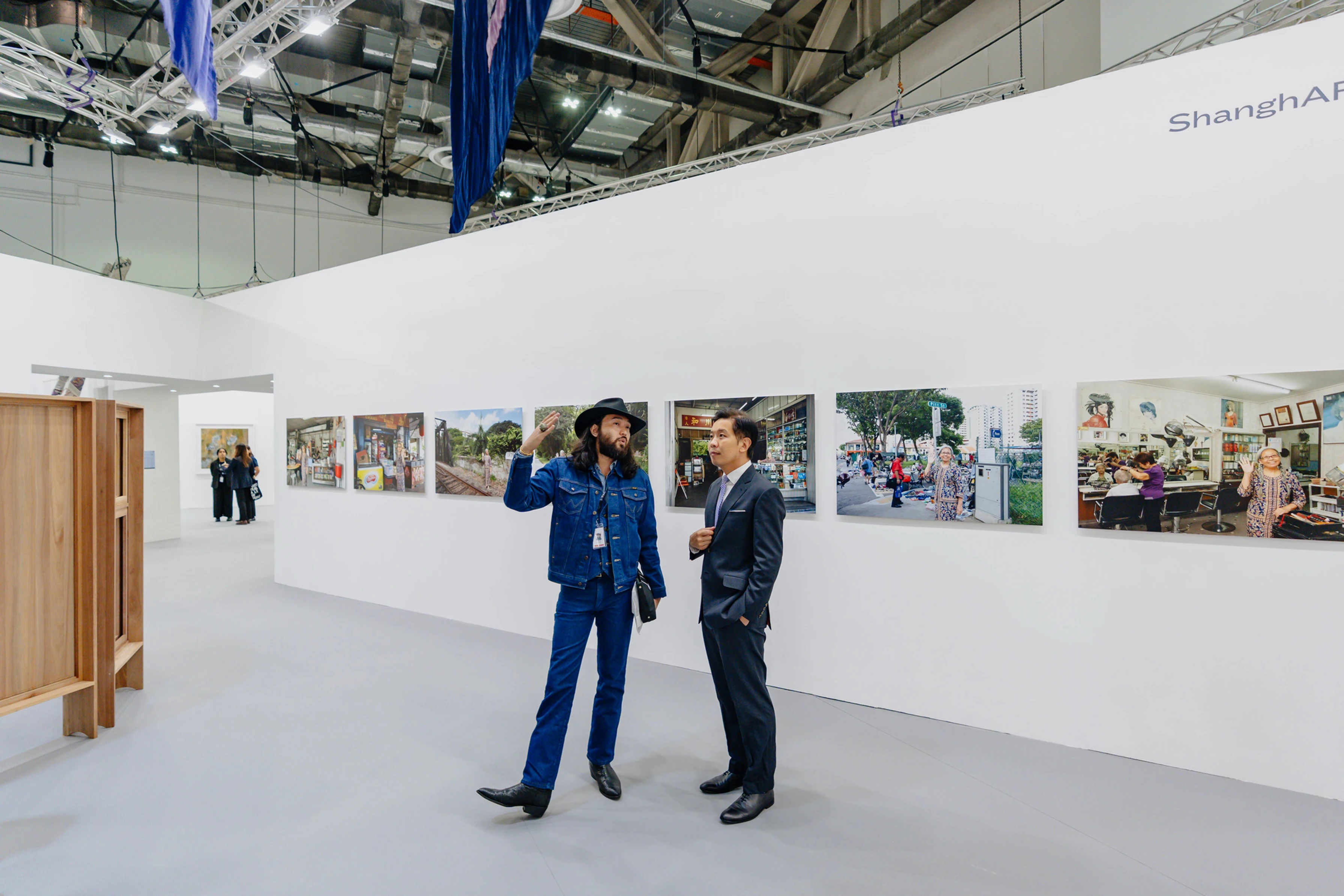
    When John Tung talks about curating, he begins with a toolbox, a literal one. Fresh from the close of the 2026 edition of SEA Focus at ART SG, Tung has a get your hands dirty attitude to exhibiting. “We had a really strong response,” he says. “[feedback was] very positive from most of the visitors… I’m very happy with how it turned out.” Behind the fair’s success lies a philosophy of exhibition-making that is far removed from the glamorous stereotype of the jet-setting curator.

    “People imagine stylish outfits and opening nights,” he jokes. “But I’m a hands-on curator. Behind me right now are toolboxes and scaffolding. My hands are beaten up and I am wearing workwear.” For Tung, the word “curate” returns to its Latin root, curare — to care. “Are you a parent? If you have never changed a diaper, I’ve said, is my approach to curating… There’s blood and sweat behind them — hopefully not tears.”

    Read on for our full interview Q+A covering SEA Focus, ART SG, curating, and cultural capital in the region, expectations, and more.

    On SEA Focus moving into ART SG

    Sarah: Previously SEA Focus was in a separate location, and now it’s inside the fair. How did that change the way you curated the show? SEA Focus has often been described as more of a museum-like experience than a typical fair booth.

    John Tung: That museum-like quality has really been part of SEA Focus’s identity for many years, especially since it moved to Tanjong Pagar District Park about five or six years ago. SEA Focus is a curated platform, so the experience is always closer to going to a museum than visiting a typical art fair booth.

    I’ve had the pleasure of creating three editions — two at Tanjong Pagar Distripark and this most recent one at ART SG. Each edition aims to create a very different visitor experience from the previous one.

    The approach stayed largely the same, but the venue made a difference. A convention hall is a tabula rasa — a blank slate. It gives you a lot of freedom to build walls exactly the way you want. In the previous venue, we had columns and architectural features we had to work around. Having a blank slate gives more opportunities to exercise creativity.

    For this edition, we centralised X-shaped walls, which became quite iconic, and in previous editions, we modelled the “islands” of the layout to resemble the archipelagos of Southeast Asia. A lot of effort goes into the selection of galleries and artists, considering geographic representation, gender representation, and where artists sit in terms of market presence. The experience is always carefully curated.

    Sarah: How do you think this curatorial platform helps bring in smaller galleries? 

    John: The galleries are actually a very diverse mix. They’re not necessarily all small galleries. Yes, you have new and emerging galleries, but you also have international powerhouses that have participated in numerous editions of SEA Focus as well.

    The unique thing about SEA Focus is that it’s an opportunity for artworks and artists to be contextualised among peers who are practicing in the region. Whether they’re established or emerging, they’re working within the same epoch. Their concerns are aligned; they’re living in the same zeitgeist.

    That’s the greatest value SEA Focus brings. Unlike a typical fair, where each gallery has its own objectives and commercial interests, here everything converges under a singular kind of territorial and conceptual banner. I think we’re starting to see that there is value in seeing connections and contextualising works, rather than just seeing them as individual commercial presentations.

    I thought it was really interesting that with the new Art Basel in Qatar [which opened from February 5–7, 2026], they’ve actually adopted a very similar approach — each booth is supposed to present one artist, they’re all thoroughly screened, and they’re expected to unite under that same singular banner. So this idea of having a curated experience — not purely a fair — we’re starting to see that there’s value in seeing the connections and contextualising the work as well.

    Installation view of SEA Focus at ART SG 2026, Marina Bay Sands Singapore

    What collectors bought at SEA Focus and ART SG 2026

    Sarah: What were some of the most popular themes or works with collectors? Or even some surprise sleeper hits?

    John: [He jokes] I’m a horrible person to ask because I have got such a close working relationship in the realisation of the show. So every work always stands out to me as really unique and really special. 

    There was strong support for many of the young artists. Inez Katamso, for example, did very, very well, which shows collectors are very interested in a younger generation of artists.

    A group of young artists presented by Mr Lim’s Shop of Visual Treasures also saw almost all the works picked up by collectors. But then again, on the other end of the spectrum, a new installation by Robert Zhao was one of the first works acquired during the preview days. So, collector interest remains very broad in Singapore. People are looking at works across a great variety of price points, and SEA Focus is able to provide that range, from recent graduates and newly emerging artists to very established historical figures.

    Cultural capital in Singapore, the region, and the artist sentiments behind it

    Sarah: Do you think Southeast Asian artists are under pressure to explain their region to the world?

    John: I wouldn’t put it as pressure, but there is definitely awareness of how the international art world wants to frame Southeast Asia, and sometimes there’s active resistance against that. [On the platform Something Curated] I wrote an article recently about this notion of Southeast Asia being “up-and-coming.” Up-and-coming benchmarked against what? Are we talking about sales, infrastructure? Western models are still predominant in those conversations.

    Art doesn’t operate like Keynesian economics. In that regard, I think Southeast Asia remains very, very true to themselves. It provides a supply for a demand that doesn’t exist yet. Southeast Asian artists remain very true to themselves. They respond to issues they’ve engaged with for a long time, drawing on distinct and hybridised histories. There’s still very strong cognisance of the postcolonial nature of Southeast Asia’s existence, and that manifests quite clearly in the work.

    Sarah: Singapore is positioning itself as a regional cultural capital — what does Singapore enable that other cities don’t, and why? 

    John: My academic background is not in curating — it’s in cultural policy. I wrote my master’s thesis on the evolution of Singapore’s cultural policy. The notion of being a cultural capital is not new, and Singapore’s model draws from quite a variety of global sources.Even the United States’ Cold War policies come to mind, with the CIA funding abstract expressionist exhibitions abroad as a means of soft power. Singapore isn’t at war with anyone, but there is definitely a desire to be seen as a gateway to Southeast Asia.

    SEA Focus allows people to see some of the best and most recent offerings from across the region in one destination, instead of flying to eleven different countries, to tease it out, to do the excavation, bit by bit. Singapore is leveraging on a lot of its strengths, its history of strong bilateral ties with our neighbours in the region, and the confidence that our neighbours have in Singapore to be able to accurately represent and reflect the variety of tastes, beliefs, and opinions of the different peoples of Southeast Asia.

    That being said, I think it’s also a really heavy burden to bear, the burden of representation, right? So I think, for Singapore, as a commissioner for many of these events, the best they can do is find individuals who take this sort of responsibility seriously. And I would like to think I take this responsibility seriously.

    The growth of private museums in Southeast Asia

    Sarah: Shifting to the art scenes more broadly. How do you think the art scenes in other major Southeast Asian cities are changing?

    John: Across Southeast Asia, particularly in the more developed cultural production centres like Jakarta, Bangkok, and Kuala Lumpur, we’re seeing a rise in private museums being opened. MAIIAM opened fairly recently in Bangkok, and there’s MACAN in Jakarta.

    In Singapore, that trend isn’t manifesting at quite the same scale as in the region. Such as The Private Museum by the Teo Family. There’s also an influx of collector-established art spaces. So I do think that across the region, patrons and benefactors of the arts are really putting their resources where their mouths are, creating infrastructure that runs parallel to state-funded spaces. That’s helping to build a more diverse and vibrant ecosystem overall.

    Sarah: What do you think about collectors opening private museums?

    John: I recall the establishment of MAIIAM in Thailand, which is the project of a really notable collector, Eric Bunnag Booth. His rationale for establishing MAIIAM was quite straightforward. At that point in time, there wasn’t a permanent collection-based institution or museum in Thailand showing Thai art. He very much wanted Thai people — young artists, young students — to have the opportunity to see iconic works of Thai art in Thailand itself.

    Singapore was the regional powerhouse in collecting at the time, but he wanted a place where local countrymen could encounter their own art history. I wholeheartedly believe in the purity of his intentions and vision in establishing MAIIAM, and I think MAIIAM has really been a beacon in the region for how a private museum can be established, run, and operated.

    The space I am currently associated with, Project Art Hunter, was established by another notable Singaporean collector, Yeap Lam Yang. It’s nowhere near the scale of MAIIAM — it’s a relatively small space, about 1,600 square feet. Over the next couple of years, he plans to present a series of rotating exhibitions drawn from his own collection. At the same time, he’s also a well-known patron of the National Gallery Singapore and the Singapore Art Museum, having donated more than 100 works to these institutions. 

    But we need to be cognisant that not all works in a private collection fit well into an institutional context. Collecting institutions have their own acquisition strategies. Just because a collector wants to donate a work doesn’t mean the museum will accept it, if it doesn’t align with their particular strategy. So that leaves many works residing in private collections with limited avenues for public presentation, unless collectors establish their own spaces.

    For a private collector, their strategy does not have to align with institutional goals. They don’t need to chronicle art history in a structured way. Ultimately, private collections reflect tastes and sensibilities. As much as we want to prioritise academic research and art historical frameworks, we shouldn’t forget that one of the biggest catalysts for the development of art over the last 600 years has been connoisseurship. That is what private collections represent. Being able to see and experience the works and collecting preferences of these individuals is valuable. Not just for people who can afford to collect, but also for those who haven’t started collecting or cannot afford to collect as well.

    Quick Fire: The reality of curating, how and why, and what’s next for John

    Sarah: What do you think is one of the most misunderstood things about curating — and the part that’s not glamorous at all?

    John: If you just Google “typical curator,” even myself, right, it’s someone in a funky outfit or a business suit, looking glamorous at an opening. But there are many different types of curators, and I’m very much a “get my hands dirty” kind of curator.

    I’m a strong believer that curatorship comes from the Latin word curare, which means “to care.” And care manifests in many ways. Are you a parent? If you have never changed a diaper, I’ve said, is my approach to curating. What doesn’t get captured in press photos — outside of the fancy outfits — is that there’s a lot of blood and sweat, hopefully not tears, that go into the execution of an exhibition. My hands are literally the most beat-up things in the world right now after Singapore Art Week. It’s going to take a while to recover. But it’s the dirty side of the job that I think makes me love it the most.

    John Tung at SEA Focus 2026

    Sarah: What do you want visitors to feel as they leave one of your shows? What questions do you hope they walk away with?

    John: I think sometimes curating today is seen as this very abstract, theoretical, almost sexy thing — exploring material sensibilities, territorial ideas, all these conceptual frameworks. But at the end of the day, I’m still quite old-fashioned in that sense.

    “With pretty much every exhibition I work on, I always ask myself: what is the moral of the story? What should a visitor be walking away feeling?”

    In its recent edition, SEA Focus, for example, looked at violence perpetrated against people, the ecological crisis, and displacement. I want people to think more deeply about how well we’ve been doing as stewards of this planet. And frankly, we’re doing horribly, as far as I’m concerned.

    So when people go into my exhibitions, I want them to think about the issues I’m raising, which I sometimes put quite explicitly in the curatorial statements. My approach to curating an exhibition is actually the delivery of policy, but in a democratic way. If we think of policy as a form of social engineering, the state might have legislation, schools might have rules, and you’re obliged to follow them. But with an exhibition, you can consider my propositions. You can decide whether you want to buy into that set of beliefs or not. To me, that’s a very democratic way of delivering policy.

    Sarah: And last question — what do you have coming up this year, and what are you most excited about?

    John: I am opening an exhibition tomorrow night called Homecoming. It’s the third edition of a suite of shows I do annually with a good artist friend of mine, Kim Whye Kee.

    For this upcoming edition, I am really excited because, beyond Kim himself, we have a collaborator who’s also presenting, Royston Tan, the acclaimed director of 881 and many prominent works in local cinema. For the first time in 14 years, he’ll be presenting a new video installation. It consists of documentary footage of 100 families in Singapore having dinner.

    So the exhibition is a rumination on home and the rituals of eating, families coming together at the dining table, and a deliberation on what the notion of home, or coming home, really means. That opens tomorrow night [7th February 2026]. 

    Follow curator John Tung and his upcoming exhibitions, including Homecoming and future projects with SEA Focus and Project Art Hunter, as he pushes conversations around Southeast Asian art, cultural policy, and exhibition-making across the region. 

    at johntung.com or @johnsavage.fromthewoods

    [All Images Courtesy of Sutton Communications]
  • A Second Chance at Impressionism: NGV’s French Impressionism Show

    A Second Chance at Impressionism: NGV’s French Impressionism Show

    The National Gallery of Victoria’s restaging of French Impressionism from the Museum of Fine Arts, Boston arrives with a sense of both elegance and excitement (6 Jun – 5 Oct 2025). Drawn from Boston’s renowned holdings, more than 100 paintings by Monet, Renoir, Degas, Pissarro, Manet, Cassatt, Morisot, Signac and Sisley bring to Melbourne audiences a movement whose radical brushwork, saturated colour and novel viewpoints changed the course of art.

    The 2025 presentation makes up for the pandemic‑curtailed 2021 run and also marks the 150th anniversary of the first Impressionist exhibition. It is part of the Melbourne Winter Masterpieces series—an annually anticipated blockbuster—but the curators have emphasised letters and journals to foreground the artists’ voices, hinting at a deeper engagement beyond spectacle.

    Immersive Design and Staging

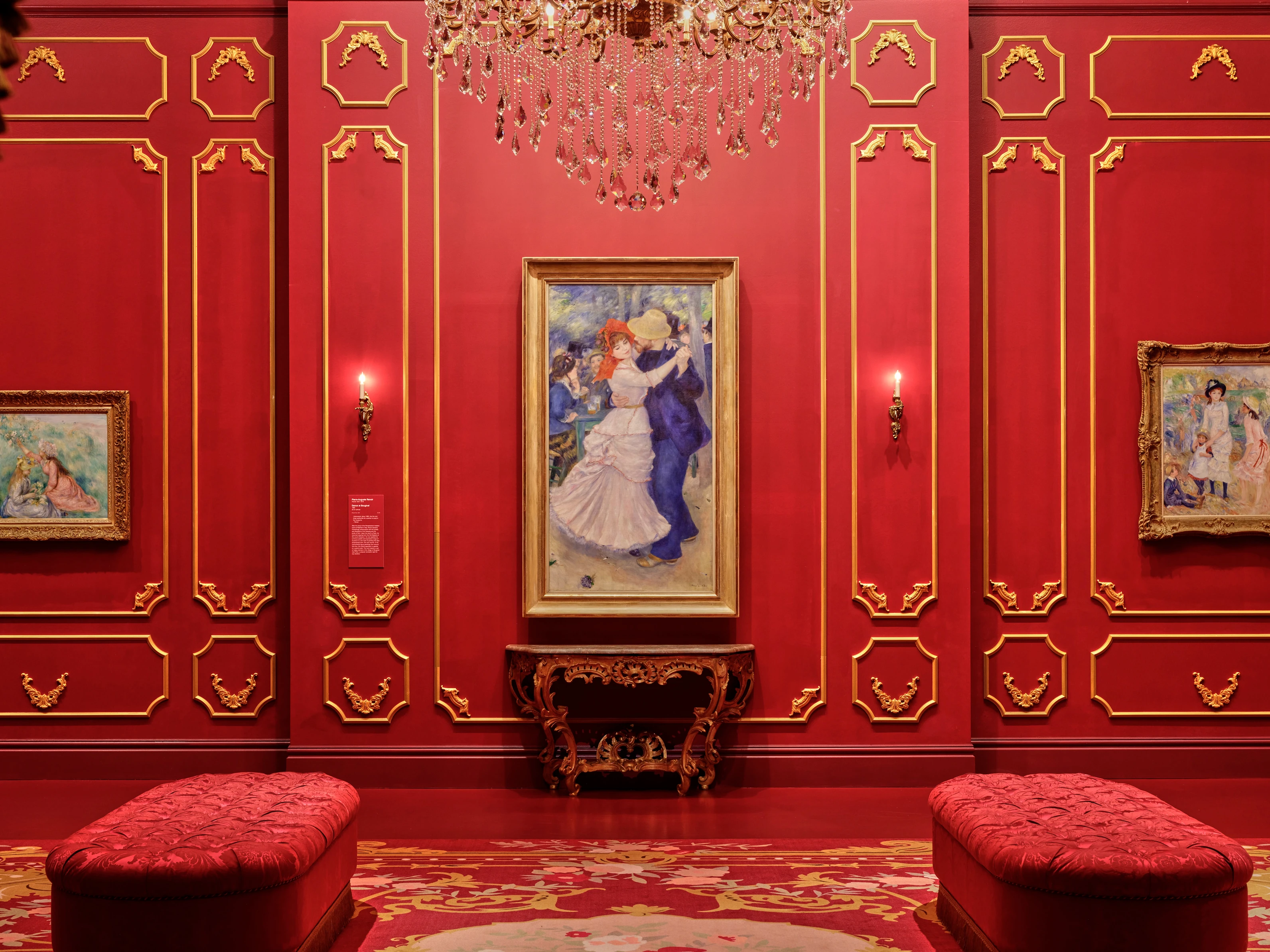
    Visitors enter through a long corridor dressed like a Bostonian drawing room, complete with parquet floors, columns and padded furniture; only two works—Renoir’s Woman with a Parasol and Small Child on a Sunlit Hillside and Monet’s Meadow with Poplars—hang on the walls. The scenography, inspired by East‑Coast collector mansions, situates the paintings within the period’s domestic elegance and hints at the American collectors whose taste shaped the MFA Boston’s holdings. Throughout the show, rooms shift mood: dark green damask for the Barbizon predecessors, duck‑egg stripes and lattice trim for watery gardens, embossed wallpaper and faux gaslight for urban realism, and opulent red‑and‑gold salons for Renoir’s experiments. It is a theatrical approach that immerses visitors in fin‑de‑siècle atmospheres while blurring the boundary between gallery and set.

    An entrance draped with luxurious green curtains leads into an elegantly designed gallery, showcasing a mirror and framed painting on the walls.

    Rhythm of Galleries and Highlights

    After the opening, more traditional hangs return, with thematic rooms dedicated to precursors, still life, urban scenes, and printmaking. A suite of Henri Fantin‑Latour’s roses, Cézanne’s fruit, and Berthe Morisot’s delicate needlework invites quiet contemplation, the next gallery dives into gritty cityscapes and Pissarro’s mentor‑and‑mentee relationships. The crescendo comes in a lilac‑white space filled with sixteen canvases by Claude Monet, including Water Lilies (1905) and Grainstack (Snow Effect) (1891), which demonstrate his obsession with changing light over decades. A final corridor of black‑and‑white photographic portraits of the artists and a projected film of Monet in his garden creates an intimate epilogue.

    A serene water lily pond depicted in soft colors, featuring floating lily pads and blossoms on a calm surface reflecting the sky.

    Highlights and Surprises

    • Self‑portrait by Victorine Meurent — A revelation in the exhibition, Meurent’s inclusion acknowledges her as an artist, not just Manet’s model. Her self‑portrait, with butter‑yellow silk and violet bow, asserts a confident painterly gaze and adds a feminist thread to the narrative.
    • Jean‑François Raffaëlli’s The Garlic Seller – This realist canvas of Paris’s outskirts brings working‑class grit into the show, reminding visitors that Impressionism intersected with social realism.
    • Degas’s Degas’s Father Listening to Lorenzo Pagans Playing the Guitar – Recently conserved, this double portrait emphasises domestic intimacy and sound, contrasting with Degas’s more familiar ballerinas.

    Get your tickets to the show here.

    National Gallery of Victoria / 180 St Kilda Road, Melbourne VIC 3004 / Daily 10am–5pm / enquiries@ngv.vic.gov.au / www.ngv.vic.gov.au

  • A tour by Wolfgang Tillmans at David Zwirner Hong Kong

    A tour by Wolfgang Tillmans at David Zwirner Hong Kong

    David Zwirner’s Hong Kong gallery put on a solo exhibition of Wolfgang Tillmans in The Point Is Matter from 25 March to 11 May, 2024.

    From soft atmospheric moments, intimate still lifes and portraits to abstract studio videos. Spanning two floors, the photographer and artist presents his work as if in conversation with each other, meticulously planned to get the most out of the white-walled space. Tillmans’ universal perspective comes through in new and old works originating from his travels to Addis Ababa, Berlin, Lagos, and Mongolia, alongside those rooted in Hong Kong and Shenzhen, forging a link to local sensibilities.

    “Hong Kong as a subject matter, is infinitely interesting, fascinating because it is such an international place with, obviously, Chinese culture and its own culture. I mean, I’ve felt moved here every time by the incredible energy, resilience, and joy,” says Tillmans. The pivotal figure of contemporary art took our photographers on a tour of the Hong Kong show, look on through their eyes and in his words…

    A man in a white t-shirt stands in an interior space with windows, softly lit in warm tones.
    Wolfgang Tilmans pictured.
    An art gallery featuring a photograph of a man lying on the floor, presented in a framed display on a white wall. The adjacent wall has a large opening leading to a softly lit orange space.

    “This installation is the result of a long evolving conversation or thinking about this space. Yesterday I saw [another] photography exhibition, which was very traditional, which showed one photograph next to the other frame. And it just reminded me of 1992, when I developed my style of installation, I mean, it was a natural reaction. For me, I couldn’t do anything else because why would I show everything in a line when I’m actually in the space? Since a young age, I have loved churches, I loved museums, I love the spatial experience of art. And that is the privilege that we have in these laboratories,” says Tillmans during the tour.

    Interior view of a modern office space featuring a large blackboard with colored sticky notes, framed by a white wall.
    Art gallery interior with visitors examining artworks and interacting, featuring large photographs on white walls.

    “This is not like a time-lapse. This is how fast the Earth rotates. And then the moon slips through the view of the camera and all the videos are set to songs that are part of an album that will be released next month. The piece is set to pictures that are filmed during the printing process of my book, abstract pictures in a giant printing press for colour offset printing press, and I like to go to the press to see the exact colours of the printing. And then, of course, when the run goes to the machine, you have nothing to do, and I just love the sound of the machines, just peeking through all the holes and different ways of where the ink is replenished on top. What was being printed were my abstract pictures. The subject matter was so well suited to this abstract composition. The whole thing with this kind of work is paint in liquid ink.”

    “These works in these spaces relate to my thinking about the world that surrounds me. Even though my thoughts are so often occupied with the past and the future, with thoughts, concepts, spirituality, and emotions, all of that is ultimately round and around matter. The very how things feel and how things work. And some could say what is he talking about? The most basic truism, everything matters. But I hope some people can sense this sense of being in the now, being respectful of your environment, trying to understand things. Also being constantly open to look at things from different perspectives and be open to change.” says Tillmans.

    All images were taken by Jennifer Tang and Shek Po Kwan.


    The Point Is Matter

    Wolfgang Tillmans Solo Exhibition
    March 25–May 11, 2024
    David Zwirner Hong Kong
    5–6/F, H Queen’s,
    80 Queen’s Road Central

    Find out more at David Zwirner.

  • Art Basel Beyond Miami: The Rise of Global Art Weekends

    Art Basel Beyond Miami: The Rise of Global Art Weekends

    Art Basel has redefined global art culture, and its international outposts in Hong Kong, Paris, and São Paulo are setting new standards for high-end art curation. Explore the shift towards art tourism, exclusive VIP previews, and the billion-dollar deals happening behind closed gallery doors.

    Luxury art fairs have evolved from single-city events into globe-trotting cultural extravaganzas. High-net-worth collectors now hop between Art Basel 2025 editions and other international fairs as if following a fashion week circuit, turning each event into a lavish “art weekend.” What began in Basel and Miami has expanded to global art weekends in Paris, Hong Kong, and São Paulo – a shift that is redefining cultural tourism and the art world’s social calendar. Billionaires, museum patrons, and design-forward jet-setters descend on these destinations for VIP art previews, multimillion-dollar deals, and indulgent afterparties. It’s a new era where business, culture, and pleasure meet against exotic backdrops.

    Paris+ Par Art Basel: The European Jewel

    Paris has re-emerged as the jewel of the global art circuit. Launched in 2022, Paris+ par Art Basel quickly became a magnet for the international art elite. Art Newspaper reports the 2023 VIP preview was “heaving, and with a lot of Americans,” one dealer observed, standing by a $40 million Rothko on display. In fact, there were more American collectors at Paris+ than at Frieze London the week prior, and galleries clinched eight-figure sales in hours – David Zwirner’s gallery alone moved a $6 million Kerry James Marshall painting on opening day. Beyond the fair itself, the city amplifies the experience: luxury maisons host private dinners in gilded salons, five-star hotels brim with VIPs and celebrities, and exclusive previews at the Louvre or Fondation Louis Vuitton make the city’s art weekend a bold blend of culture. The result is a cultural tourism boom, with Paris harnessing Art Basel’s glamour to reinforce its status as an apex destination for art and luxury travel.

    Hong Kong: Gateway to Asia’s Art Elite

    If Paris offers Old World grandeur, Hong Kong delivers high-octane cosmopolitan flair. Art Basel Hong Kong has become the gateway to Asia’s art elite, where Eastern and Western collectors converge amid skyscraper views and Michelin-star dining. The nights leading up to the fair are packed with underground parties and gallery soirées, as top collectors often jet out soon after the first VIP day. In 2025, one art insider’s itinerary included an elegant Cantonese banquet hosted by a gallery at Mott 32 and a posh afterparty thrown by Gagosian at the Mandarin Oriental – all before the fair even opened. When the doors opened on March 26, the VIP preview drew throngs of prominent collectors and curators seeking early access to coveted works. Attendees noted a measured approach to buying, yet the atmosphere stayed buoyant. Beyond the convention center, Hong Kong itself becomes an art playground: think curated museum nights, gallery hops in Central, and city-sponsored pop-ups. In one novel twist, the Hong Kong Tourism Board installed a traditional Cha Chaan Teng café inside Art Basel Paris to entice global visitors to experience Hong Kong’s culture. The city’s luxury hotels like the Rosewood and Peninsula are fully booked with VIPs, and private jet charters between Hong Kong and other art capitals spike during the fair. In short, Art Basel Hong Kong has cemented itself as an unmissable stop on the luxury art fairs circuit, blending cutting-edge art with the dynamism of Asia’s world city.

    Photo courtesy of SP-Arte
    Photo courtesy of SP-Arte

    São Paulo: Latin America’s Turn in the Spotlight

    In São Paulo, Brazil’s financial hub, an Art Basel-like atmosphere is thriving at the annual SP–Arte fair. The 2025 edition of SP–Arte – Latin America’s largest fair – saw nearly triple the number of foreign collectors and curators compared to recent years. An influx of international collectors, from New York and London to Doha and beyond, signals a renewed appetite for Latin American art on the world stage. Indeed, São Paulo’s edition offers a refreshing complement to the frenetic pace of Basel or Hong Kong. Collectors spend afternoons browsing modernist Niemeyer-designed pavilions and evenings at gallery dinners in Jardim Europa or rooftop caipirinha receptions overlooking Ibirapuera Park. The city’s renowned restaurants and hotels join in, crafting bespoke experiences for the art crowd – think chef-curated menus at D.O.M. for visiting patrons or after-hours parties set to bossa nova beats. By embracing global art weekends, São Paulo has positioned itself as Latin America’s cultural capital, proving that the art-market jet set will happily add a South American stop to their annual grand tour.

    Basel 2024. Photo Courtesy of Art Basel
    Basel 2024. Photo Courtesy of Art Basel

    From VIP Previews to Private Jets: The New Art World Itinerary

    Welcome to an art world where VIP art previews are just the beginning of a luxe weekend itinerary. At each global art fair, invitation-only preview days see the “cream of the art world” queue up amid bustling aisles and bottomless champagne flutes. These first-look events are as much about networking and scene-making as they are about buying art. VIP programs offer concierge service and exclusive access that blur the line between commerce and leisure – one could start the day with a private collection visit or an artist’s studio tour, enjoy a catered lunch in the VIP lounge, then head to a VIP art preview at the fair. Evenings bring glitzy afterparties at iconic venues, where collectors, artists, and celebrities mingle. In Miami Beach, this might mean dancing under the stars at a seaside villa; in Paris, a midnight fête at a Palais; in Hong Kong, business deals sealed over late-night M+ parties. By the time the weekend wraps, billions of dollars in art have traded hands globally – total art sales topped $57.5 billion in 2024– and countless new connections have been forged over cocktails and canvases.

    What’s clear is that global art weekends have transformed art fairs into destination events that transcend geography. From Paris and Hong Kong to São Paulo, Art Basel and its peers are redefining cultural tourism by marrying high art with high living. And as the art caravan moves from one glamorous city to the next, the art weekend has become the ultimate luxury escape, proving that in the 21st-century art world, business class and culture now share the same itinerary.

  • Dark Mofo and MONA in Hobart: An Insider’s Guide.

    Dark Mofo and MONA in Hobart: An Insider’s Guide.

    From MONA, Night Mass, Altar to the Odeon Theatre, find out where to go and what to see.

    Dark Mofo is synonymous with artistic exploration, immersive experiences, and provocative displays, a winter festival for arts, culture and music in the heart of Hobart. This year, the two-week-long festival brought in the likes of Black Flag, Eartheater, Tianzhuo Chen, Laurel Halo, Dean Hurley, Max Richter, Ryoji Ikeda, Berlin Atonal, and ¥ØU$UK€ ¥UK1MAT$U. Alongside a new vanguard of Australian artists from GLVES, Tasman Keith, V, Arcana, Kaylani, Kinder and OKENYO.

    Then across the waters is MONA — Museum of Old and New Art — founded by David Walsh and accessible via a 25-minute ferry ride from the city in an art-deco bar boat. On show now is Oceans of Air (17 December 2022—24 July 2023), a solo exhibition of Tomás Saraceno that approaches the Argentinian artist from a native lens. Paintings, sculptures and interactive works are on view to reflect our relationship with nature, society and spiders.

    AT MONA

    Oceans of Air, curated by the in-house team Emma Pike and Olivier Varenne, separate the exhibition into over eleven rooms of dark-walled encounters with nature. Within the subterranean galleries, a serenity follows as you walk through the maze of literal spider webs in Webs of At-tent (s)ion. Then there are declarations of ‘Invertebrate Rights’ and sound installations that make up a wire-strung symphony.

    The 4pm orchestra show is a project by Tasmanian musician Dean Stevenson, who writes a new piece of music every day from scratch and performs it at 4pm with a different ensemble of musicians. Grab a drink and sit in the open lounge, or for something more private behind closed green curtains The Lady’s Lounge for high tea. Then there is Event Horizon by James Turrell, an immersive experience of the Ganzfeld Effect, leaving you feeling lost between the beginning and end.

    Newly opened inside the MONA Library is a recording studio open to public bookings with a viewing glass to studio sessions by The Frying Pan Studio. Inside is original equipment from The Beatles Abbey Road Album, Pink Floyd and The White Stripes. Be part of history.

    Western Flag, John Gerrard, Dark Mofo 2023. Photo credit: Andy Hatton, 2023.
    Western Flag, John Gerrard, Dark Mofo 2023. Photo credit: Andy Hatton, 2023.

    DARK MOFO

    A two-week-long winter festival for arts, culture and music that takes over the city of Hobart at night.

    NIGHT MASS

    Unveiling Hobart’s Underground from Altar, The Grand Poobah, The Alleway and an Underground Cinema.

    In Altar, graffiti-clad walls set the scene as international DJs deliver melodic techno, bass, and trance on the upper floors. Downstairs, immerse yourself in hardcore metal, rap, and raunchy drag shows that defy convention. With every hour, new performers take the stage until dawn.

    Seek solace in Poobar’s back room, where tarot card readings intertwine with string melodies and theatre performances of the oracle predictions. As you venture further into the labyrinthine depths of Nightmass, stumble upon the underground cinema nestled by the Alleyway entrance. The Alleyway hosts loft DJs surrounded by outdoor campfires, where the underground cinema offers satirical theatre and drag bingo.

    And if you’re lucky enough to enter the coveted Red Room in the Odeon Theatre, prepare to be enchanted by boundary-breaking performances. Be quick, though, as space fills up swiftly once a show concludes, or you’ll be lining up for hours. Night Mass is an immersive journey into Hobart’s underground scene.

    TRANCE Photo credit: Rosie Hastie, 2023.
    TRANCE Photo credit: Rosie Hastie, 2023.

    But the stand out performance showcasing underground sub-cultures was TRANCE by Tianzhuo Chen (Thu 8 – Sat 10 June). The ‘3 day rave’ put on three 12-hour long performances in an immersive nature-scape with art installations, interpretive characters, bass DJs and music performances. Artists from around the globe flew in to participate including Dis Fig, City, KIM KHAN, Lavinia Vago, OMI, and ¥ØU$UK€ ¥UK1MAT$U.

    ODEON THEATRE AND IN THE HANGING GARDEN

    Two music venues for international and local acts in a historic theatre and open-air stage.

    The opening night show In The Hanging Garden tilted The Gathering — saw powerful verses of BARKAA, the alluring flow of Tasman Keith, and the soulful dameeela. These remarkable First Nation artists forge a profound connection with the audience and land, setting the tone for the rest of the festival. Amidst this symphony of sounds, In The Hanging Garden is a multi-level outdoor venue adorned with cathedral-like light installations serving local wine or food from wild wallaby, pepperberry and more.

    Then at the Odeon Theatre, its architecture is reminiscent of a bygone era. The ornate details, from the intricately carved pillars to the rich tapestries adorning the walls, create an atmosphere of musical grandeur. PS. It’s the location of The Red Room, but only expect a seat if you arrive by midnight when doors open.

    As for the shows, the first weekend saw Black Flag’s unapologetic energy and Thundercat’s instrumental jazz, while Ethel Cain’s haunting melodies closed out the weekend.

    Enter the ethereal realm of Borderlands I, where Dean Hurley and Laurel Halo, two electronic composers from the United States, created soundscapes of tension and cinema to sit back and relax too. The second weekend for Borderlands IV will host Tujiko Noriko, Hiro Kone, KMRUKEN and Hüma Utku for their rendition of the electronic music concept.

    Crosses, Dark Mofo 2023 Photo credit: Rosie Hastie, 2023.
    Crosses, Dark Mofo 2023 Photo credit: Rosie Hastie, 2023.

    WINTERFEST AND DARK PARK

    Feed the body at Winterfest and the soul at Dark Park this winter solstice at Dark Mofo.

    As the frosty air wraps the city in its embrace, the people come out to play at night. Winter Feast beckons, a nightly feast where local and international cuisines intertwine over communal tables, fire pits and live music. From spit roasts, seafood, local wines and craft beers, the indoor-outdoor halls lit from neon red crucifixes and hourly fireworks have their own rugged charm.

    Spectra, Ryoji Ikeda, Dark Park, Dark Mofo, 2023 Photo credit: Remi Chauvin, 2023.
    Spectra, Ryoji Ikeda, Dark Park, Dark Mofo, 2023 Photo credit: Remi Chauvin, 2023.

    Dark Park, nestled within the former industrial site of Macquarie Point, blends raw and weathered elements with contemporary design. As you traverse the landscape, Spectra commands attention with its towering presence. A monumental beam of light crafted by Japanese artist Ryoji Ikeda can be seen throughout Hobart. But the ancient ritual of Ogoh-Ogoh genuinely captures the spirit of Dark Park. The pinnacle event is on the festival’s final night, as the Ogoh-Ogoh is set ablaze. In this ritual, the audience is invited to write their hopes, dreams, and wishes on paper, which they then cast into the bonfire. A practice of catharsis and release to end the two-week-long festival of art, culture and debauchery.

    Winterfest and Dark Park become the epicentre of Dark Mofo’s enchantment as the winter solstice casts its spell.

  • Jeremyville’s Community Service Announcement Art for All

    Jeremyville’s Community Service Announcement Art for All

    Looking for a daily dose of joie de vivre? Don’t delay; take a journey to Jeremyville now.

    Meet Jeremyville, New York-based multidisciplinary artist harnessing the power of art to inspire change and positivity in the world. Welcome to his world, a creative state of mind that takes you to a happy place. Jeremyville is everywhere with his distinctive graphics and recognisable community service announcements. His work is always at the edge of your vision, from a floor-to-ceiling mural in a fast-food restaurant to a performance animation for a well-known fashion brand. In this interview, the artist reveals how he translates life through artistic practice.

    Using graphic language and your own experiences growing up, how do you inspire others?

    My struggles growing up involved finding a way to a life where I could truly be myself, not a pale imitation. I could never be someone others expected me to be. I needed to be true to myself. That’s more difficult than it sounds. Life has a way of trying to make you something you are not. I needed my strangeness, and I made my weirdness work for me. Weirdness can become our ‘fascinating individuality’ if we create that alchemy.

    I was a solitary child and didn’t have friends growing up. I only had myself to create a dialogue with. This led to great clarity in my life by going inward in my mind to find the answers to my questions. WHO AM I? That’s a question I still ask myself every day. The journey towards the answer creates my daily road map.

    With my comic stories, I try to convey a simple path that anyone can take to arrive at their answers. Each of us has specific challenges and goals. I try to keep my messages open to others’ interpretations. That way, anyone can connect with the messages in my art, assign meaning to it and make the journey their own.

    Start your day with a touch of whimsy, and take a minute to make your daily road map. Find the Jeremyville “relax” daily calendar full of playful reflections for a positive mindset.

    What appeals to you about the style of graphic art?

    I aim to communicate a feeling or idea as quickly and simply as I can. I utilise an easy-to-comprehend graphic language. A recurring theme of symbols, icons and characters that tell a story to connect with.

    How do you remain optimistic about life and what you can achieve?

    My greatest obstacles are in my mind. If I can overcome them, anything is possible. If I can dream it and think about it, I can plan it and do it. What does society or others know about what I can and can’t achieve? Only I know that. If I try and fail, then I’ll just dream again and try again. Failure is fine, but giving up is not fine by me. My dreams and aspirations are very real to me. It’s like if I can think it and imagine it, then that’s 90% of the way there, and the 10% is in the doing. I stopped thinking too much and started feeling more. I believe in dreams, not reality.

    “Let’s get lost in beauty.” Open your mind to Jeremyville’s signature community service announcements; they’re out in the world promoting self-love and happiness. You might spot one, and if you know, you know.

    'Lunar Introspection' by Jeremyville
    ‘Lunar Introspection’ by Jeremyville

    How do you plan around life crises during times of emotional confusion?

    I start my day with a list; each day, it’s my daily road map. All I have to do is write it down (usually the previous night in bed or first thing in the morning). I go through my day, checking off each task. My diary is full of completed lists. Life is just a series of incremental movements. For my emotional life, I find that by getting stuff done and keeping occupied, my mind does not dwell on difficult things I can’t control. I’m too busy ticking stuff off the list. Once you shift that mental focus onto the daily task, you find that your mind has moved on from your emotional troubles. Action is a great way of shifting our focus to a more positive place. Just keep moving, just keep doing, no matter what. Just get stuff done.

    In times of uncertainty, how do you find your inner self?

    Art grounds me by taking me out of the every day into a place that feels like an eternity. Time becomes irrelevant, just an abstract construct. I reach a level of truth that I do not always find in life. Each of us can find something, anything, that provides a key that opens the door to a journey inward. For me, it is a session of drawing or painting. For others, it could be meditation, playing a favourite song, cooking a meal for a loved one or going for a run. Anything that takes us outside ourselves and makes the troubles we are experiencing less important, less of a focus.

    Art is truth for me. Art is beauty, passion, struggle and resolution. Art and love are everything to me. It’s my way of navigating this life. We all have something that can do that for us. If you haven’t found it yet, keep on searching; it’s there.

    Seek your dreams, stop thinking and start feeling. Find your happy place. This is the message expressed in the unique Jeremyville language.

    How is your work influenced by idealism?

    The look of my art probably has a positive feeling on others, but for me, I see the struggle and tension in the art I create. It takes a lot of hard work and introspection to get me to a place of positivity. Mistakes are my greatest teacher, and all my lessons are hard-won victories.

    Viewing art that outwardly is positive and discovering this comes from a place of deep learning for the artist personally is a reminder nothing in life worth having ever just falls in your lap.

    How do you maintain your self-assuredness in yourself and your work?

    From my humanity, from my struggles. There is always a way to reach a positive outcome in life. It just requires time, patience, hard work, introspection, and belief in yourself. Life is never easy, but we can choose a positive outcome if we want it enough and work for it. My confidence in life comes from a belief that anything is possible if we see life that way.

    Take a trip to Jeremyville, and choose positive outcomes for yourself in a place where anything is possible if you see life that way.

    Find the artist on Instagram @jeremyville and artwork at jeremyville.com

    All images courtesy of Jeremyville.

  • Taipei City Guide

    Taipei City Guide

    In the heart of Taiwan, Taipei shines as a modern city reflecting a rich culture and history dating back centuries. The vibrant night markets, old Buddhist temples, and world class exhibitions and bars present a contemporary city where hints of tradition shine through. Read on for our guide to a hidden gem in the East…

    STAY

    Grand Hotel

    airplane landing near grand hotel taipei
    Photo by Wei86 Travel on Pexels.com

    This temple-styled palace building is a mix of tradition and contemporary touches with rooms made up by red columns and gilded tiles. The sublime view of the Keelung River and Yangming Mountain ahead makes the atmosphere even more delightful. Comforts that are friendly family comes suit with this cultural gem.

    Grand Hotel, No.1, Section 4, Zhongshan North Road, Zhongshan District Taipei City, 104427

    grand-hotel.org/

    @grandhoteltaipei

    Humble House Taipei

    A modern outdoor swimming pool surrounded by contemporary buildings. The pool features a wavy blue mosaic pattern and is bordered by sun loungers and umbrellas, set against a backdrop of sleek high-rise architecture and a clear sky.

    Humble House is conveniently located within Taipei’s central business district of Xinyi District. Atop a shopping mall, the hotel also offers a view of the renowned Taipei 101 skyscraper. Find peace within their minimalistic style, alongside installations that merge art with living. Comfort and curiosity collide.

    Humble House Taipei, No. 18, Songgao Road., Xinyi District., Taipei 110, Taiwan

    http://humblehousehotels.com/

    @humblehousehotels

    DINE

    Mitsui

    A piece of fish being grilled on skewers over an open flame.

    Dine at a local favorite devoted to creating dishes from natural, locally sourced ingredients. This Japanese fine diner is easy two or family, pick from an extensive ala carte menu from Wagyu to fresh seafood platters, sushi, to Nigiri Omakase sets. On a long night out, don’t forget to complement your meal with sake or their curated list of Australian and European import wines.

    Mitsui, No.34, Nong-an Street, Taipei City

    mitsuitaipei.com.tw/

    Salt and Stone

    After stopping at Taipei 101 swing by this East-West fusion haunt serving delectable house-made pastries, pastas, and pizzas. Sit down and unwind with a drink from a rich menu of local teas, beers, and cocktails.

    Salt and Stone, 4F., No. 45, City Hall Road, Xinyi District, Taipei City, Taiwan 110

    @saltandstone.tw

    DRINK

    INDULGE Bistro

    A close-up of a green cocktail served in a martini glass, set against a dark bar background with blurred bottles in the background.

    A European-inspired bar true to its name. Indulgence, decadence and debauchery for the night owls that flock. Chester-field style leather couches in demure surrounds with crystal-studded light fixtures, and awe-inspiring drinks adapted from Taiwan’s local tea traditions. Bottoms up.

    INDULGE Bistro, No. 11, Lane 219, Section 1, Fuxing S Rd, Da’an District, Taipei City, Taiwan 106

    indulgebistrotaipei.blogspot.com/

    VISIT

    Taipei Fine Arts Museum

    Mission & Vision

    Taipei Fine Arts Museum pushes contemporary art exhibitions alongside local Taiwanese artists and international curators sharing their cultural perceptions in art and design. Most recently, TFAM hosted the 12th Taipei Biennial, which showcased the museum as a “planetarium” to examine people’s diverse perspectives on geopolitical affairs and the ecological crisis.

    Taipei Fine Arts Museum, No. 181, Section 3, Zhongshan N Rd, Zhongshan District, Taipei City, Taiwan 10491

    www.tfam.museum

    @tfam_museum

    Longshan Temple

    ornate facade of zushi temple in new taipei
    Photo by Will Chen on Pexels.com

    The 300-year-old temple in Taipei’s Wanhua District will take you on a spiritual journey to visit the Buddhist deity, “Guanyin” known as the “Goddess of Mercy.” Being one of the ‘big three’ temples of Taipei, Longshan is a venerable cultural relic for people in Taiwan. After several reconstructions, it remains an embodiment of traditional folk art with halls and altars cast in bronze, and fine stone and wood carvings.

    Longshan Temple, No. 211, Guangzhou St, Wanhua District, Taipei City, Taiwan 10853

    Shilin Night Market

    people gathered on the street during night time
    Photo by niguo on Pexels.com

    For both locals and tourists alike, night markets in Taiwan are an exciting culinary experience for all. Filled with bright lights and tantalizing food aromas, Taipei’s Shilin Night Market offers an euphoric eating experience in a central marketplace, with food vendors, amusement arcades, souvenirs, and boutiques. Come for the buzz of a crowd that goes ‘til late

    Shilin Night Market, No. 101, Jihe Rd, Shilin District, Taipei City, Taiwan 111

    @shilin_nightmarket

  • Landing in Vienna

    Landing in Vienna

    I’ve never been a morning person and I couldn’t tell you the last time I purposefully woke up to catch a sunrise. But one frosty morning in Vienna at 05:30, I was awoken by an impalpable energy coursing within me that I could only interpret as the siren call of the Viennese city below me. Its cultivated cityscape awash in staggering shades of crimson coloured Morgenrot set fire to my soul, famished for culture and immediately did Karl Kraus’ quote spring to mind, “The streets of Vienna are paved with culture, the streets of other cities with Asphalt.” At once my eyes were drawn to the Hofburg Imperial Palace with its enchanting palatial domes of turquoise and tiffany-blue, reminiscent of its former Habsburgs Empire who ruled first over the Austrian patrimonial lands from the days of the Holy Roman Empire until its final days of reign over the Austro-Hungarian Empire at the end of the first world war. Just a kilometer away stands Vienna’s historical jewel St Stephen’s Cathedral, an illustrious incomplete monument which exhibits the city’s fascinating and ever-shifting historical landscape in all its non-traditional gothic, Romanesque and zigzag-tiled roof architectural amalgamated glory. As ruby hues gave gradual way to a florid orange glow and morning light swept through the rousing downtown, illuminating the distant landmark giant wheel of the Wiener Prater just across the water in Leopoldstadt and even further back, sleek and modern skyscrapers emerged into visibility. Like every other aspect of this carefully curated city of blended cultures, the contrast between New vs Old Vienna somehow fuses together tastefully with the impressive DC Tower I soaring above simplistically elegant rows of Biedermeier neoclassical townhouses, reflecting dazzling strokes of golden light onto the legendary Danube River. It inspired me to reflect upon the insurmountable centuries of change, of paradigm shifts, of revolution, restoration and reconstruction – and how these cities and the stories left behind will outlast us all, as they did the Romans, their Imperial Reich, the logical empiricists of the Vienna Circle and the occupation of the National Socialists.

    These curious little existentialist whispers remained with me throughout the rest of my visit in Vienna, because nothing makes the passing of time feel quite as surreal as this timeless historic city with its immaculate paths and pristine façades maintained to appear as if it, miraculously, simply stood the test of time. As I ambled along storybook cobblestone alleys and passed by the stately traditional Wiener coffeehouses of the historic Ringstraße’s innere Stadt, I quietly observed the elegantly understated aura of the Viennese folk around town. I have always somewhat considered imitation to be the highest form of flattery and so I thought to myself, “When in Wien, do as the Viennese do”. I popped on Johann Strauss’ 10-minute waltz ‘An der schönen blauen Donau ‘, straightened out my posture and donned the uniform demeanour of Austrian aloof affability as one so naturally does on their morning stroll down the Canal; Semmel bread roll in one hand, coffee in the other. I even tipped my head ever so slightly and greeted passers-by with a lilting “Grüß Gott!”, deliberately letting my roll ever so delicately, doing right by the famously melodic Austrian German dialect.

    By afternoon, I was hopelessly besotted with the city after having fallen into an artistic trance at the Kunsthistoriches Museum from gazing up at the lavishly painted arches and columns of Gustav Klimt. I walked back out onto the large sprawling main streets lined with their sumptuous mix of baroque, gothic, neo-renaissance and classical buildings and headed straight for the Burggarten where I found myself at the foot of Mozart’s monument. For a few minutes, I simply looked up at the composer’s stone visage and basked in my admiration and gratitude for his arias and sonatas which were musical comforts throughout my childhood. “Danke schön” I whispered in thanks to Mozart, to Vienna, to no one in particular really, but to the unparalleled experience of learning and discovering such abundant beauty and culture that it seizes you with inspiration and reignites our inner artist, our musician and our creator who lives within each and every one of us.

    Image Courtesy of Maxime Evangelista
    Image Courtesy of Maxime Evangelista

    This article is from our Vienna diary feature available to read in print. Get your limited edition copy here.