The Beijing rapper brought to Melbourne a deep-cut show of emotion.
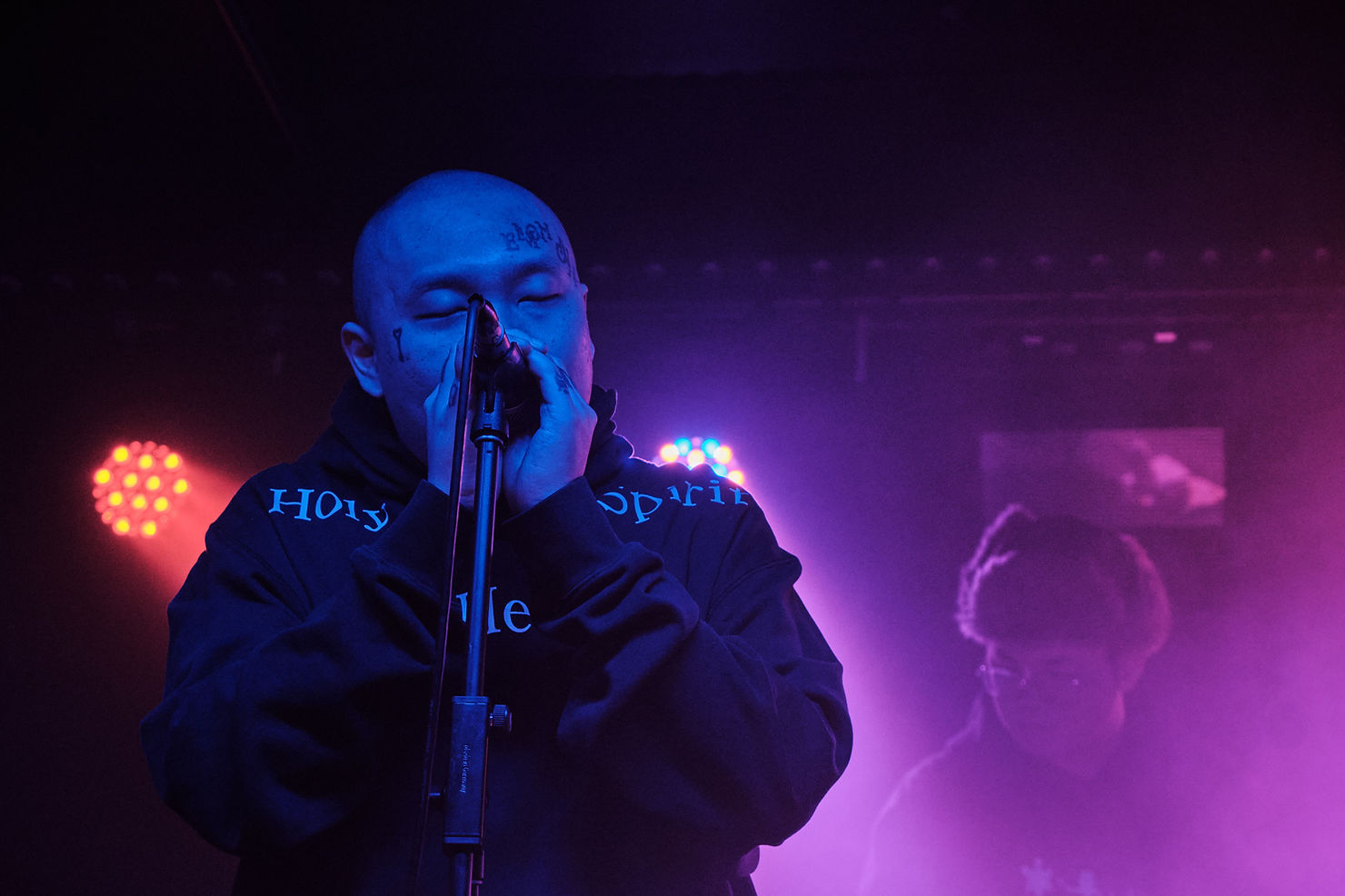
In the world of cloud rap, few artists carve out a niche as distinctively as Bloodz Boi. The rapper debuted on Australian shores and played two intimate shows in Melbourne and Sydney. He is known for his lyricism, lo-fi beats, and a stage presence that commands attention. The Melbourne show provided a raw, unfiltered look into his heart. We met up with the artist in tow, so read on as Yang Fan sheds light on his introspective approach to music and performance, and a desire for authenticity over fame.
Sarah Wei: Is this your first time in Australia?
Bloodz Boi:Yeah, first time.
SW:What do you think motivates your music?
My life, yeah, I think my life. Right now, it’s mostly from my life, and maybe just art in general influences me. As soon as I start fighting with my mind… It’s not a very serious thing.
SW:Is it the same when you create a set for a performance?
I don’t perform a lot. I don’t want people to see me because every time I perform, I have to reface every scene I created from my songs.
My music and songs are careful and are not from good memories. So, while singing them, I want to make them very legit, make myself be there, make myself very sad or something, to feel that. I want to give the people 100% of what I am thinking. It is the emotions that are way more important than anything else.
It’s like revisiting your emotions… Once you make a song or once it goes out to the public, do you ever revisit it?
No, I don’t listen to my music. I have taken down a lot of music. The feeling is right now. I always change.
SW: Why were you drawn to cloud rap?
Because I’m a soft person. I don’t have a hard style; I am living myself. I don’t like the high energy.
SW: And what about DJing? Do you still do that?
DJ for radio is good enough [currently Bloodz Boi hosts for NTS Radio]. I don’t like to DJ offline.
You don’t enjoy it as much?
Yes. Sometimes, I will. DJing is like karaoke to me. I am saying, you can’t go to karaoke every week, or you will lose your passion. I listen to a lot of music, so I like to listen to it on a club monitor.
SW: Do you feel much impact from the nightlife in Beijing?
Like before 2019. When Dada [a Beijing club] opened, the first day I was there. The very old, the old one. I was in high school at that time. My music was influenced a lot.
SW: Did you find a sense of community there?
Yes. I made a lot of friends in Dada. I have a very good friend in high school, we grew up to grow up together. I’m older than him, and after his final high school exams in China, I brought him there the same day. Now, he DJs there, every weekend, there or someplace else in Beijing. I have met a lot of interesting people, but I have lost them in the last four years because I don’t talk to people.
SW: Would you want to reconnect with them?
I don’t want to be here in any community now, I don’t want to socialise. I only have one or two friends in Beijing. My very close friends don’t listen to my music, they’re not about the music. Never listen to my music, please. Like, I want people to know me. So, my real name is Yang Fan, I want people to know me.
On the internet, it’s really interesting. Like people, if they saw you making music, they saw you as an artist, and then saw your listing. They think you are very famous.
When people see you making music, they recognise you as an artist and then notice your fame. But the truth is, anyone can make music these days, much like anyone can send an email. But why? Oh, [because you] got to do something, you know? So, there are not many people making music like ours. I don’t want to trade myself.
SW: How about China’s underground music scene?
If you are an underground artist, you are an underground artist; there is no crossover into the mainstream. If you are commercial, you are getting big. Rich and poor. There is no crossover.
SW: Is your collaboration mostly from your online friends?
From different countries, talking different languages. Music is not about the language or anything else. So it’s really good. We can meet through the music.
SW: Is there any artist you really want to work with?
I want everything just natural. You know? For some people I make music with, it wasn’t because I like their music; it was just because I like this guy. And it’s way more than music.
Like, I am a fanboy of some people as well. But I don’t want to break the feeling. I just want to listen to them, I don’t want to make music with them.
If we make music, I want it to be natural. We meet, get to know each other, and then make the music.
SW: Then, does each new track become individual to the artist?
Yes, right, right. I never make a song where it’s just half a song, and here you go, do the rest. No, I won’t do that. Every song is just for him or for her.
SW: How much of your identity do you tie to your music?
Yes, all of them. I mean, I want the people to like me, for me. The music is a part of me. In the music, I can express all of myself. It is more than the music. It is the real me. There are some people who tell me it’s too real. Like this is too much. They can’t take it. This is too heavy… Like last night [at the concert], I tried my best. But the set up was not good, and it might have made people misunderstand.
[At his Melbourne show, Bloodz Boi reperformed songs multiple times].
Some people really come for me. I have to do that. I have to do that for them. I want them to feel, to listen, to my set and receive the vibe.
Find Bloodz Boi’s music, tours, and radio shows here.
From MONA, Night Mass, Altar to the Odeon Theatre, find out where to go and what to see.
Dark Mofo is synonymous with artistic exploration, immersive experiences, and provocative displays, a winter festival for arts, culture and music in the heart of Hobart. This year, the two-week-long festival brought in the likes of Black Flag, Eartheater, Tianzhuo Chen, Laurel Halo, Dean Hurley, Max Richter, Ryoji Ikeda, Berlin Atonal, and ¥ØU$UK€ ¥UK1MAT$U. Alongside a new vanguard of Australian artists from GLVES, Tasman Keith, V, Arcana, Kaylani, Kinder and OKENYO.
Then across the waters is MONA — Museum of Old and New Art — founded by David Walsh and accessible via a 25-minute ferry ride from the city in an art-deco bar boat. On show now is Oceans of Air (17 December 2022—24 July 2023), a solo exhibition of Tomás Saraceno that approaches the Argentinian artist from a native lens. Paintings, sculptures and interactive works are on view to reflect our relationship with nature, society and spiders.
AT MONA
Oceans of Air, curated by the in-house team Emma Pike and Olivier Varenne, separate the exhibition into over eleven rooms of dark-walled encounters with nature. Within the subterranean galleries, a serenity follows as you walk through the maze of literal spider webs in Webs of At-tent (s)ion. Then there are declarations of ‘Invertebrate Rights’ and sound installations that make up a wire-strung symphony.
The 4pm orchestra show is a project by Tasmanian musician Dean Stevenson, who writes a new piece of music every day from scratch and performs it at 4pm with a different ensemble of musicians. Grab a drink and sit in the open lounge, or for something more private behind closed green curtains The Lady’s Lounge for high tea. Then there is Event Horizon by James Turrell, an immersive experience of the Ganzfeld Effect, leaving you feeling lost between the beginning and end.
Newly opened inside the MONA Library is a recording studio open to public bookings with a viewing glass to studio sessions by The Frying Pan Studio. Inside is original equipment from The Beatles Abbey Road Album, Pink Floyd and The White Stripes. Be part of history.
Western Flag, John Gerrard, Dark Mofo 2023. Photo credit: Andy Hatton, 2023.
DARK MOFO
A two-week-long winter festival for arts, culture and music that takes over the city of Hobart at night.
NIGHT MASS
Unveiling Hobart’s Underground from Altar, The Grand Poobah, The Alleway and an Underground Cinema.
In Altar, graffiti-clad walls set the scene as international DJs deliver melodic techno, bass, and trance on the upper floors. Downstairs, immerse yourself in hardcore metal, rap, and raunchy drag shows that defy convention. With every hour, new performers take the stage until dawn.
Seek solace in Poobar’s back room, where tarot card readings intertwine with string melodies and theatre performances of the oracle predictions. As you venture further into the labyrinthine depths of Nightmass, stumble upon the underground cinema nestled by the Alleyway entrance. The Alleyway hosts loft DJs surrounded by outdoor campfires, where the underground cinema offers satirical theatre and drag bingo.
And if you’re lucky enough to enter the coveted Red Room in the Odeon Theatre, prepare to be enchanted by boundary-breaking performances. Be quick, though, as space fills up swiftly once a show concludes, or you’ll be lining up for hours. Night Mass is an immersive journey into Hobart’s underground scene.
TRANCE Photo credit: Rosie Hastie, 2023.
But the stand out performance showcasing underground sub-cultures was TRANCE by Tianzhuo Chen (Thu 8 – Sat 10 June). The ‘3 day rave’ put on three 12-hour long performances in an immersive nature-scape with art installations, interpretive characters, bass DJs and music performances. Artists from around the globe flew in to participate including Dis Fig, City, KIM KHAN, Lavinia Vago, OMI, and ¥ØU$UK€ ¥UK1MAT$U.
ODEON THEATRE AND IN THE HANGING GARDEN
Two music venues for international and local acts in a historic theatre and open-air stage.
The opening night show In The Hanging Garden tilted The Gathering — saw powerful verses of BARKAA, the alluring flow of Tasman Keith, and the soulful dameeela. These remarkable First Nation artists forge a profound connection with the audience and land, setting the tone for the rest of the festival. Amidst this symphony of sounds, In The Hanging Garden is a multi-level outdoor venue adorned with cathedral-like light installations serving local wine or food from wild wallaby, pepperberry and more.
Then at the Odeon Theatre, its architecture is reminiscent of a bygone era. The ornate details, from the intricately carved pillars to the rich tapestries adorning the walls, create an atmosphere of musical grandeur. PS. It’s the location of The Red Room, but only expect a seat if you arrive by midnight when doors open.
As for the shows, the first weekend saw Black Flag’s unapologetic energy and Thundercat’s instrumental jazz, while Ethel Cain’s haunting melodies closed out the weekend.
Enter the ethereal realm of Borderlands I, where Dean Hurley and Laurel Halo, two electronic composers from the United States, created soundscapes of tension and cinema to sit back and relax too. The second weekend for Borderlands IV will host Tujiko Noriko, Hiro Kone, KMRUKEN and Hüma Utku for their rendition of the electronic music concept.
Crosses, Dark Mofo 2023 Photo credit: Rosie Hastie, 2023.
WINTERFEST AND DARK PARK
Feed the body at Winterfest and the soul at Dark Park this winter solstice at Dark Mofo.
As the frosty air wraps the city in its embrace, the people come out to play at night. Winter Feast beckons, a nightly feast where local and international cuisines intertwine over communal tables, fire pits and live music. From spit roasts, seafood, local wines and craft beers, the indoor-outdoor halls lit from neon red crucifixes and hourly fireworks have their own rugged charm.
Spectra, Ryoji Ikeda, Dark Park, Dark Mofo, 2023 Photo credit: Remi Chauvin, 2023.
Dark Park, nestled within the former industrial site of Macquarie Point, blends raw and weathered elements with contemporary design. As you traverse the landscape, Spectra commands attention with its towering presence. A monumental beam of light crafted by Japanese artist Ryoji Ikeda can be seen throughout Hobart. But the ancient ritual of Ogoh-Ogoh genuinely captures the spirit of Dark Park. The pinnacle event is on the festival’s final night, as the Ogoh-Ogoh is set ablaze. In this ritual, the audience is invited to write their hopes, dreams, and wishes on paper, which they then cast into the bonfire. A practice of catharsis and release to end the two-week-long festival of art, culture and debauchery.
Winterfest and Dark Park become the epicentre of Dark Mofo’s enchantment as the winter solstice casts its spell.
Lexi Vega from Los Angeles-based band Mini Trees speaks on the shift from drumming to songwriting, and how the pandemic and self-discovery play into her music.
Interview by Ashmitaa Thiruselvam
Paradigm Haus: Can you please tell us about the beginnings of your music career and how it came about?
Lexi Vega: I’ve been playing and writing music ever since I was a kid but it wasn’t really until Mini Trees (in 2018) that I decided to actually try making something of it. Prior to that, I had been gigging in other people’s projects, playing the drums and kind of just taking a backseat to the whole thing. But I really enjoyed getting to play with so many people and I think it set me up really well to start my own project.
PH: I heard that you were initially a drummer, why did you choose to further explore your creativity through singing and songwriting?
LV: Songwriting is something that I’ve always done but used to reserve for personal self-reflection. It took me a while to get over the initial embarrassment of sharing something that felt so deeply vulnerable, and I think that’s honestly what held me back from doing so for so long. Mini Trees kind of came about by accident. The other bands I was playing in at the time all happened to be on hiatus, so I found myself with all this extra time to write and work out my songs in the studio with my friend and producer Jon Joseph. From there, things kind of just started to take off.
PH: The tracks in your latest album Always in Motion hold so much meaning and draw attention to your personal experiences. Why do you feel it is important to create music in light of your past?
LV: For me, songwriting has been a really important and helpful tool for processing and dealing with my past. It’s allowed me to search down deep and uncover emotions or feelings that I didn’t really know were there, and to also vocalize and “let them go”. I’ve found it to be an incredibly healing way to process it all.
PH: I noticed that Always in Motion has also been produced as a Japanese CD on your website. What was the reasoning behind releasing a Japanese adaptation?
LV: Early on in chats with my label (Run for Cover) I mentioned that I wanted us to partner with a Japanese label/distributor like Tugboat so that I could share my music more widely with Japanese audiences. My Japanese heritage has played a major role in my songwriting, especially the songs that deal with identity, so having unique Japanese releases felt like a small way to celebrate that.
PH: Your album and EP Slip Away were released during isolation. Has the pandemic impacted you as an artist? Did it maybe help you in some ways too?
LV: The forced “slow down” that the pandemic brought is what led me to write the album when I did. I was initially expecting to spend a lot of 2020 on the road to support the EPs but like everyone else, I was forced to stay home and rethink everything. All of that extra time to sit at home and process my thoughts definitely helped inspire the album; it was written entirely in 2020. It wasn’t all easy though; I definitely struggled with the isolation from family and friends and had a lot of anxiety and fear to work through. I know we’re not out of the woods yet but I’m grateful to be able to hug my family again.
PH: Congratulations on announcing your performance alongside Hovvdy’s shows in May and June of 2022. It must be super exciting! What are some things fans can expect when they see you perform?
LV: Thanks, I’m super excited! We’ll be touring as a full band and probably playing a lot of songs off the LP but we’ll definitely get the hits from the EPs in there as well.
PH: What can listeners look forward to for the future of Mini Trees?
LV: Well, I’m not planning on stopping or slowing down any time soon so hopefully a lot more music and touring. I’ll be on the road here and there this year (including the UK/EU this summer) and in between that I’m just focusing on writing and planning whatever the next thing is.
Listen to Lexi’s latest album Always in Motion on streaming platforms.
We asked Lexi Vega from Mini Trees for her current top picks in songs, local indie artists and tips while going on tour with cult-favorite Death Cab for Cutie.
This is part of our ‘Rapid Fire’ Series from our interview with Lexi Vega.
Interview by Ashmitaa Thiruselvam
Lexi Vega’s Top 5 Songs Right Now
Medium Build “Rabbit”
(Medium Build, Rabbit, 2021)
I just met Nick of Medium Build at SXSW and he has become a dear friend. I also just discovered that his music is absolutely incredible, so this one is one of my favs.
Fenne Lily “Hypochondriac”
(Fenne Lily, Hypochondriac, 2020)
My friend was just on the road with Fenne Lily which is what led to me hearing this song. It’s awesome and has a very epic key change moment.
Mitski “The Only Heartbreaker”
(Mitski, The Only Heartbreaker, 2021)
I’ve been a Mitski fan for a long time so it’s no surprise that I fell in love with the new record. This song pumps me up and makes me feel like I’m in an 80’s training montage.
Tristen “Alone Tonight”
(Tristen, Sneaker WavesAlbum, 2018)
My Nashville friends introduced me to Tristan when we were on the road last winter. I wasn’t previously familiar but her songwriting and catchy melodies hooked me immediately.
Hiroshi Sato “Say Goodbye”
(Hiroshi Sato, Awakening Album, 1982)
I’m extremely late to the party on this one. I just recently started getting into Japanese city pop and Hiroshi Sato is one of the greats. Absolutely love the synths and grooves on this song.
It’s a marathon, not a sprint haha. Try to eat healthy, don’t drink too much, get good sleep, etc. My essentials would include headphones, a journal, and my coffee set up. I like taking moments to chill out and be alone in the morning and being able to brew myself a cup of coffee feels like a nice little slice of home.
Percussionist and multi-disciplinary artist Angela Wai Nok Hui, tells the narrative of her youth spent between Hong Kong and London through her collaborative project Let Me Tell You Something. Still relevant today, the show examines identity, relationships and memory through the performance medium.
Paradigm Haus: How did you feel after Let Me Tell You Something?
Angela Hui: I can tell you how I felt right after the show. Wing is my producer and we are good friends as well. She told me that she had a strange feeling but she didn’t know how to describe it. However, I didn’t feel that way because I have experience performing and I don’t get this kind of “post-show depression”.
I’m using the show as a medium to express my feelings to the world and to Hong Kong, to London and to my family and friends. The show is me and I am a person that doesn’t know how to use words as you can tell maybe.
Let Me Tell You Something, Image Courtesy of Angela Wai Nok Hui (by Dimitri Djuric)
PH: I saw one of the photos where you picked a branch off the street, how did you choose different mediums and how are they all tied together?
AH: I collaborated with different composers. The composer Gregory Emfietzis has a piece called “Hestia”, which means “goddess of fire”, “goddess of home” and “goddess of a home setting”. That piece is interesting because Greg made this card game with a set of instructions. I composed the whole piece with his instructions, so the composition is the input of that piece.
For the main component, Greg tried to make me tell a story in front of the audience and he also told me it would be great to find any objects that are related to the story. I chose a full flowerpot and a baby’s glockenspiel, which is a toy instrument used throughout the whole program. This baby glockenspiel appears in Lucy’s piece and Jasmin’s pieces. Then there were normal bricking sticks, which I didn’t choose.
PH: What does collaboration mean to your creative process?
AH: Collaboration is very important for me. Collaborating with people is like talking to people. Because I am a classically trained percussionist. I went to the Royal College of Music. I spent six years playing a lot of notes, marimba, timpani, Beethoven, symphony, counting bars, triangles and all that. I love them. I enjoyed the experience. But then I always find it’s a little bit lonely when I’m practicing in my own practice room. I enjoy collaborating and making stuff in a whole different way that I wouldn’t even think of before asking people to join me, to have a jam.
This whole project started more than two years ago. Two pieces for Angus Lee, a Hong Kong composer, are actually finished. The final version finished in 2019 with Timothy Cape, where I made a very weird dance next to a bass drum. He is based in Italy, he would have come to London to work with me if not for the pandemic. We were doing videos back and forth. We were looking for weird and different sounds and we were jamming. He was making projections for me to have a feel and then I told him my feeling. But then he would say “maybe that’s not how I want you to feel, so maybe let’s do something else.” I work with composers, so I need to trust that person and open my heart to them.
With Jasmin’s piece, This Land is Yxxr Land, people could interpret the title of the piece differently. This piece is very personal. It was basically during an interview with me. She tried to record the interview and then put it into a new looping tape. It sounds not true at all, very emotional, but whenever I play that piece, I recall all of the memories that I told her. It makes me smile. Especially the first performance in Hong Kong, lots of friends and family came. I don’t know why the first performance is mostly for friends and family. Then the second is that of more colleagues.
The first performance is the first piece of the show as well. I did not play the pre-show cassette, so I used this piece to bring people into my world and I try to use the cassette as a gateway for them to come in.
So when I played that piece on the first night, it really was special because a lot of people that I’ve talked about in this piece were all there in the venue. It was creepy and it gave me goosebumps. That was a special moment, I didn’t expect that. Even one of my aunties bought tickets and came. She was in one of the events or one of the memories that I talked about.
PH: Then how do you think the audience affects your performance?
AH: Comparing day one and day two, I would say performing in Hong Kong, in general, is different from what I normally do. In London, my family wouldn’t be there. If there’s a piece that I need to be naked, I could do that. But in Hong Kong, I can’t do that. Even though I can do that, I have to go through lots of mental preparation to do that. But I haven’t really thought about why I’m having that feeling.
PH: Can you compare your experiences in Hong Kong to the scene in London where you’re normally based?
AH: Not to say that London is having a good time as well. I think there is the same problem everywhere in the world. It is fine, we have to deal with problems that’s kind of our life.
Audiences in London are more open minded and willing to support artists. I don’t know if that is the case because ticket prices are cheaper?
In Hong Kong, I didn’t know that my show could be sold at $250HKD, which is expensive. The shows I went to in London were just around seven pounds to walk in. Early bird tickets were just five pounds. I would love to do an experiment on this, for example, what if I do a completely awful show and sell tickets for $10 in Hong Kong.
In London, people are trying to bounce off ideas more openly. I’ve been in Hong Kong for two months, including my 21-day quarantine. I have a sense of the Hong Kong music industry, which is in groups. It’s very hard from the outside to break in.
I think the observation for me, between Hong Kong and London, is that everything in Hong Kong is very, very pretty and well presented.
For example, the big font of Tai Kwun is so pretty. All the wordings and even some English I don’t even understand like “microwave”. Emails used in Hong Kong are different from how we do in the UK. Whereas in the UK or in mainland Europe, such as Germany, Belgium, they have more of the rawness of art. I can see some really, unprepared, ugly, and raw shows in London, but then I don’t think I will get to see them in Hong Kong. But maybe ugly and beautiful really depend on how you see them.
PH: Are there any kinds of trends that you’ve been noticing in experimental art or in the music scene?
AH: People all have a lot of energy, but then they don’t have the support to do it. I’m seeing this crossing of disciplines, which might be a by-product of the pandemic.
I’m a percussionist, I’m a musician and now I’m trying to do some sound and music design, which I would never have thought of before. So my by-product of the pandemic is five short movies I made for this show. People as artists are trying to see how far we could go in different directions, which is really good.
Sometimes I don’t have the normal knowledge of how to make a sound and then something interesting can come out from that. I don’t know the normal steps of making a soundtrack. That could be the element of why the soundtrack could be so bad, or so good. So that’s why a painter tries to do music, and play percussion or piano. Simply because they don’t have normal lessons on how to do it, something interesting that I wouldn’t think of would come out of this.
PH: Do you think these thematic topics of the pandemic and cross-disciplinary avenues changed how artists approach their practise?
AH: The pandemic didn’t really change what I wanted to talk about in the show. It was more about what happened in Hong Kong during these two years that changed a little bit on this show.
For me, it all started by asking myself who I am. The identity crisis, you know? Where is home? Do I have one term or do I need to go back to my home? Am I humble or maybe I have no home and I will never have a home. And then the whole movement happened in Hong Kong.
It makes me think no matter where I go, I really have a very strong bond with Hong Kong and that would never change. I think I found the answer or maybe I don’t think I would ever find it. Do I have one home or do I have no home? I could have two homes. Now I’m married to an Italian Frenchman, so here’s my home as well? But it doesn’t really matter, I think I’m just going to continue this journey.
So I think that is a little change of direction because of what happened or what is still happening now in Hong Kong, such as people leaving the country and moving away. So I’m really excited about the London one as well. I really don’t know how the audience or Hong Kongers in London would take it. What would it remind them of? Can I give them the sweetness, a bit of comfort or would I remind them of something bad? So for Let Me Tell You Something, I didn’t really tell them forcefully and spoon-fed them. I created a space for them to tell themselves something. People would get different things from the show.
One half of NYC-born band Prelow, Jesse Aicher speaks on his journey as an artist, sharing his proudest moments, musical inspirations and his thoughts on the growing independent music scene.
Paradigm Haus: Can you tell us about yourself and how you got into music?
Jesse Aicher: I started playing guitar when I was about nine, just as a little activity that my parents thought would be fun for me. Around the time I was 12 or 13 I started to realize I could learn songs that I like to listen to and write my own.
PH: Who were your musical inspirations growing up?
JA: My parents would always play the Beatles and U2 around the house, and my mom also was a tap dancer so there would be some degree of older folkier music being played. When I was old enough to choose my own music I went through a rock and pop/punk phase then a hip hop phase.
PH: Could you tell us about Prelow and how it came to life?
JA: Matt and I met in a class we were both taking at NYU in New York City. There was an assignment to group up and make a song and that’s actually how the first Prelow song was made.
PH: What have been your proudest career moments to date and why?
JA: All the touring we’ve been able to do is the most special to me. We’ve done three national tours now playing with other acts that I’d consider to be real friends. Those have been my favorite experiences.
PH: Congrats on 20million on ‘Mistakes Like This’. The first song I came across from Prelow was actually ‘I Don’t Wanna End The Night’. Both beautiful songs. Could you tell us where you find inspiration for your songwriting?
JA: Thank you! A lot of the time the inspiration comes from a musical idea or the beat. ‘Mistakes Like This’ was almost entirely produced before I wrote any lyrics or came up with any melodies. At that point, I try to just lose myself in the music and start piecing together melodies and words until it feels right.
PH: How has the independent music scene evolved in NYC? Where are you based now?
JA: I wish I could say. I’ve been fairly isolated since the start of the pandemic, between my apartment in Brooklyn and my parents’ places out of the city. I think NYC will always be a hub for independent music, there’s just too much going on here for it not to be.
PH: What’s next for you and your musical career?
JA: Currently I’m enjoying writing for other artists and working on a solo project!
Listen to Jesse’s latest release BoutU featuring Westerns available on streaming platforms.
Nina Las Vegas on creative social enterprising, multiculturalism and how it plays into Sydney’s music industry.
Interview by Sarah Wei
Paradigm Haus: Can you tell us about the first moment or memory you have that made you fall in love with music?
Nina Las Vegas: Honestly, I can’t remember that ONE moment. It’s lots of moments over lots of years, including hearing the Kelis’ Kaleidoscope, DJing at Coachella, early Heaps Decent workshops, even a Ninajirachi & Kota Banks show I worked on last month! It’s in my blood at this point.
PH: Take us through your creative process and inspirations.
NLV: I’m driven by people, things and experiences around me. I document everything, keep a diary and scrapbook, use Pinterest religiously and listen to lots of music. I usually think about where I want a song to be played and go from there with a simple beat, sample or rough vocal hook.
PH: How has multiculturalism played into Heaps Decent’s core values?
NLV: Heaps Decent has always been committed to providing resources for all young people to express themselves and their identities, no matter who they are, their background or where they are from. One of the best things about Heaps Decent projects is that often people come together from vastly different cultures and experiences, to make music or maybe visual artwork. This is a really powerful and grassroots way to make space for inclusivity, shared knowledge and respect between individuals and the communities they live in.
PH: In what ways does multiculturalism influence the music that you and your young artists create?
NLV: I make dance music, which is clearly inspired from Black music and pioneers. I love learning about regional sounds, where they are from and how I can work with their makers and communities – so I can build my own sound around my understanding of the history. I think we need to learn where things come from before we can start creating!
PH: What are the cornerstones themes and popular trends you see happening in Sydney and Australia for music right now?
NLV: I think we’re all trying to survive through COVID! It’s a really hard time to be an artist anywhere in Australia, so it’s ok to pace and really dive into new ways to make & release music – as live shows are never guaranteed.
Nina Las Vegas Boiler Room DJ Set by Boiler Room (via Youtube)
PH: Why and in what ways is the music scene in Sydney different to other major cities such as London, New York or Seoul?
NLV: Again! So hard to dive into through these Pandemic times. I think ultimately, Sydney has a much younger scene and it’s only just opening up and becoming more diverse.
PH: How have you seen Sydney’s music scene change?
NLV: Of course! West Sydney artists are taking over the airwaves and encouraging other communities to make, release and play music that showcases their identity. We are no longer a music landscape of indie, beach-side rockers!
PH: What would you like to see come out of Sydney’s music scene?
NLV: I would love to see more diversity behind the scenes. Managers, label teams, promoters coming from the community representing the community!
PH: Tell us what you’re working on now and have coming up.
NLV: It’s lots of label work (NLV Records) and not much touring! I’m also planning on returning to Wilcannia with Heaps Decent when COVID allows.
Listen to Ninas latest release, Busy (BAYLI Remix) available on streaming services.
Video: Busy (BAYLI Remix) by Nina Las Vegas. Provided to Youtube by NLV Records 2021. Released on: Jan 21st, 2021 Produced by: Nina Las Vegas, BAYLI & Swick Written by: Nina Las Vegas & Bayli Mixed by: Swick Mastered by: Joker
If, like us, you grew up with the melodies of 90’s and early 2000’s indie rock bands that can now bring waves of memories of college dorms and nostalgic youth, you’re not alone. Loyal listeners of Bellingham-born Death Cab For Cutie have followed the band’s over 20 years (and counting) journey since its inception in 1997 when then roommates Ben Gibbard (lead singer) and Nicholas (Nick) Harmer (bass guitarist) experimented in the confines of their college dorm. There’s something so powerful and authentic about its tunes that have guided emotional breakthroughs, set the scenes for warm summers, and first romances. But despite the band’s immense global success, its humble roots remain prominent in its albums, which continue to explore the indie-rock genre at different stages of life. Nick speaks to us on the Seattle music scene, Japan’s impressive vinyl stores, and decades-long inspirations.
We spoke with the bass guitarist of Death Cab For Cutie — Nicholas (Nick) Harmer.This is the uncut conversation from our artist profile feature on Nick Harmer coming out thisFall in print.
Interview by Faye Bradley and Sarah Wei. Raw interview transcribed by Cherie Cheung.
Paradigm Haus: You’ve been with Death Cab for Cutie since 1997 – the beginning. How have you evolved as a person and how has your music guided you through different stages in life?
Nick Harmer: Ben and I were really good friends and roommates before we were ever in a band together. Playing music and now 20 something odd years on, into a career together. What he’s always done as a songwriter — and we’ve always tried to do as a band — is to write music that feels honest about where we’re at in our lives. Not get hung up and try to appeal to a certain audience, but more write songs that capture our feelings about whatever life stage we are in.
In a lot of ways, our music has evolved with our age and our life experiences as we’ve moved along. When I listen back to our earliest stuff all the way through to our most recent songs, I hear that they’re like us, sort of evolving as people and how our life has changed and moved along.
Music has always been an extension of ourselves. As we’ve moved through our different life stages, we’ve all wanted our music and our art to reflect whatever we’re personally going through. And hopefully, people can relate to that or not. Sometimes people are like, “Oh, I don’t know if I really like this new stuff that they’re writing.” And ten years later when they finally catch up to that life stage, they go, “Oh my gosh, this totally makes sense to me,”. So, that’s cool.
PH: How do you balance your commercial success now with your personal relationships with Ben and the band, especially considering it’s been such a long time?
NH: We’ve always been good at changing hats. When we put on our business hats and talk about business, it’s very matter of fact. Whether it’s a business relationship or a romantic relationship, it always comes down to good communication. For better or worse, what we’ve always tried to do in the band is communicate about where we’re at, what we’re feeling, what we need, and keep that dialogue as open as possible. It’s not a perfect science. When you’re involved in music together in a collaborative way, there are lots of things around personalities, egos and everything that you get involved with.
We were really good at being able to know and compartmentalize our relationships. It’s okay that those things sometimes don’t ever cross over. We are constantly navigating, and it’s always been an extension of anything which is just one foot in front of the other when we started the band. We didn’t have any goals. But we only knew that we wanted to do the next thing in front of us. We would accomplish that and set a new goal.
To me, the commercial success that has come along has always been secondary and was never the goal. Some people start projects and they think, “well, this isn’t successful commercially. It wasn’t worth doing, so let’s just stop doing it and give up.” And I have met a lot of musicians along the way that were in bands who really didn’t connect or go anywhere. They just stopped playing music entirely because they never had commercial success. And I’m like, “Why? Did you start playing music just for commercial success?”.
So, the shortest answer is just good communication. We get caught up in making sure that everything is clear and we’re on the same page as much as possible about things. Also, there is a level of not overthinking things and follow our instincts. Now, that has worked out really well for us.
PH: What do your little victories look like now compared to when you first started?
NH: It’s funny that the same little victory still feels the same. It always starts and stops in our band with the song that we’re working on. There will always be something so satisfying about finally finishing a song together, or we hear a demo from Ben where immediately we’re like, “This connects to us!” It is never not exciting when you finish bringing something new into the world and you can sit back and go, “I really think this is a good song.” The rest of it that happens after that is all just toppings on the ice cream sundae.
It’s still fun to play shows, to go to new countries, and to do all these other things. If the music isn’t there and exciting, then the rest of it doesn’t really matter as much either. I keep coming back to every time I finish a song or we finish a song, I look at Ben and I can see him 20 years ago when we were living in this tiny apartment in Bellingham.
We were first starting out and I was hearing some of his earliest songs for the first time. I remember how I’d be blown away and said, “Ben, those are really great, let’s play music!” It’s crazy that this many years on, I still have that feeling. I can see him as the 20/22-year-old college student that I was friends with from the very beginning. But the littlest victory is still playing music and writing the songs. We’ve been writing a lot during the pandemic, even though we haven’t been able to get into a room as a band. We’ve been writing over Zoom and Dropbox.
Even though I’m not in the same room as my bandmates, there’s something really fun about finishing a song at the end of the week. We can listen back to our text threads together, and see the excitement. We still feel that victory or that joy, but I don’t even get to look at these people. Hopefully, we’ll get a chance to get in a room and play music soon enough. It’s fun to say these little victories can still translate even though we’re not in the same room anymore.
PH: Behind where you find inspirations, what has been the creative process when you’re not able to meet up with your band?
NH: That’s a good question! A lot of the songs start and stop with Ben as a songwriter, lyrically. That’s always going to be a focus of the music that we make, wherever Ben is able to find his inspiration which admittedly is very limited in a pandemic. You’re not able to get out and hear stories, talk with friends, and gather up all the kind of input that you would normally need to process your writing. I know he’s been trying to do versions of that, just reading and exposing himself to ‘others.’ Lots of others, whether it’s art and creativity, or film. We’re constantly ingesting tons of content in lieu of being able to be with other people.
We’ve tried to change things up this time by doing a ‘Round Robin’ style of writing. Did you ever play a game when you were young, called The Telephone?
For example, one person says something, and they say the next. By the time it gets to the end, it is completely different than what the first person said. We’re doing a version of that musically.
There are five of us in the band and we rotate through each day of the week, where one person starts on their instrument, with a new song. So, I’ll say I start on Monday, I’ll write a baseline with no other instrumentation, no drums, no guitars, nothing.
And I would upload it to Dropbox. Then it’s the next guy’s day on Tuesday. They download it and say it’s the drummer, and Jason will play drums. The rule is to react and to play what you get sent, and you can change it any way you want. We all kind of react to it and pass it along. By Friday, we have a finished song, and no one knows what it’s going to be except for the person who’s working on it last. It’s been fun to listen to how things shift and change, and what is motivating people.
We’re all in our individual bubbles, so we make creative choices completely in a vacuum. Sometimes it works really well, and sometimes it is a disaster.
Our inspiration is coming mainly from listening to each other and trusting this weird process that we’ve invented. To me, it’s like a weird version of a birthday party, where on Friday you get this present that you didn’t even know you wanted. It’s always fun and you’re always happy to get it. I wouldn’t say all of the records that we’re writing come together that way, but a lot of the records have come together that way. It will be an interesting one to record. And I wonder how it’s all going to come together when we finally get a chance to record because it’s a little different from how we would normally write and work, but it’s been inspiring for sure.
We’ve adapted, taken that limitation and tried to make it a strength. When we finally record these songs, we’ll see if people who know our band either say, “These are good songs, you guys really were onto something”, or, “Go back to the old way, please don’t ever do that again.” We’ll see.
PH: That’s really creative. How have you adapted your creative process, since having a few different band members throughout Death Cab’s life?
NH: Thankfully our creative process from the beginning has been fairly the same. The songs start with a demo from Ben. But I wouldn’t say it always started with him because there have been songs along the way that have been written together, in parts and pieces. If he never comes up with memorable lyrics or a melody that feels compelling, the song never goes anywhere. That’s the final checkpoint in any of the stuff that we’ve done as a band and he is the primary songwriter in the band.
From the very beginning, all of the members of the band who’ve been with us, our only job is to figure out in which ways our instruments can support his lyrics and the songs that he’s demo-ed out. He’ll bring songs to us in various stages of completion. Sometimes, it’s just a guitar and a vocal, and we’re coming up with everything around it. We all adapt to whatever information we’re given from his initial burst of creativity. It’s all about support after that.
I guess it’s more about how new people adapt to the way that we’ve been writing forever. As long as they come into the band and realize that they’re in a supporting role, and figure out ways to process that information, they’ll do just fine. Anytime it’s ever been weird is if somebody comes in and thinks, “I got to write my songs too.” We’re like, “no, that’s not this band.”
Thankfully we’ve never had any tension or stress around any of that stuff because most people understand that it comes from the top down creatively. So, we haven’t really had to adapt very much to how we work. It’s mainly how do we adapt as a unit with personalities and working out the internal chemistry that new people and new ideas bring in. I wouldn’t say that is not a challenge, but that has been more of the work than figuring out how to write and make music together. That process has always remained fairly intact, as far as I’m concerned.
PH: What are the most important values to your band?
NH: It’s always been really important to us to not get hung up in some arbitrary definition of success. A value for us has always been being honest and authentic about what we are feeling and what kind of music we want to make.
We are trying to stay as true if we can, to the music that’s coming out to us. And not feeling that we need to change to reach a bigger audience, to sell more records or tickets. I think that there is a lot of pressure when you get into the public and performance aspects of being in a band, where you start asking yourself lots of questions about, “Do we look right?”
Some people get caught up in that, but we’ve just never had that. We’ve always said, “You know what? It’s about the work, and it’s about the music.” If that’s good, we like it and we’re proud of it, then that’ll have to be enough. And if there are only 50 people in the whole wide world (hopefully more), we’re not going to change anything about ourselves. It feels disingenuous to who we are, to try and guess at what someone might like. So, a value for us has been to keep our heads down and do the work. We are a very even band.
We’ve got good communication. I remember there were some journalists that we met a long time ago and they were like, “Gosh, it’s really hard to write about you guys because there’s really nothing to write about. What’s the story? You guys are well-adjusted, nice guys that like to write music together. There’s no drama and fighting, so what’s the angle?”
And now, I think the angle is straight-up longevity. We’ve been able to do all of that and make it last. All of the things that tear bands apart after their second album or five years into their careers, or any of that stuff, we’ve been lucky to be able to escape from that for the most part.
We’ve lost some members along the way, and we’ve made some adjustments. But the band is still very much intact from how it was in the very beginning. The band started as Ben in a room recording a bunch of songs into a dictaphone by himself. And that’s the core of it from here until the end.
In some ways, there have been some changes, but it’s also been a lot of the same. I guess our values are just to be as honest about who we are, and where we’re at. And not allow us to get caught up in the trappings of the weird worlds that we sometimes find ourselves in, which can be harmful.
There’s been a lot of moments along the way that make us scratch our heads. We’re like, “I can’t believe that we’re here! We’re at the Grammys!” And we were hanging out at some party in Los Angeles with all of those crazy famous people, but we’re just not crazy famous people. I think it gets humbling over the years in a lot of ways. So that’s good.
PH: We’ve noticed a lot of mainstream music has a lot of features, collaborations and singles to gain popularity. In that way, what’s your opinion as a band that started ‘offline’?
NH: I think collaborations are awesome. If there’s something genuine about it, there’s a reason why those two artists are working together. They’re either fans of each other, or there’s something real about their connection musically. I’m a little skeptical sometimes of collaborations that were assembled by managers and agents to get exposure for people. It seems like a vehicle for something. But if the collaborations work well, they are awesome. So, I’m all for it, as far as that goes. And we’ve had collaborations with other people singing our records, but we haven’t had a true genre thing. We did something with Chance the Rapper that was fun. We were a part of Chance’s song. But we haven’t really done anything where we’ve had a Death Cab song.
To me, it just shows how much musicians listen to each other. There’s so much collaboration that happens behind the scenes, in terms of influences. There are so many bands and artists that I listen to all the time. They end up on the same record with others and it would make all the sense in the world because they’re the ones that are getting me excited about making music and vice versa. So, I think it’s a cool thing that’s happened in recent times that there is so much of it. And the ones that work are outstanding. The ones that don’t, I think everyone knows it felt a little strange.
Over from when we first started on our earliest tour, we were able to buy one cell phone and that was the phone for all of us to use. And to where we are now, it’s just mind boggling. And as I used to joke with people because we formed in 1997, people always ask what it was like when we started. I always say, “Back in the 1900’s, there were no cell phones.” It’s funny to say it like that, but it also speaks to how long we’ve been around. I can remember a conversation with a musician friend of ours named John Vanderslice, who at one point he ran a studio in San Francisco. We were recording at the studio and we were talking about stuff. He was like, “I’m telling you guys, there’s this thing coming, that’s going to change the world. It’s called Broadband Internet. The speeds are going to be so fast. We’re going to be able to watch movies and they’re going to be available to get music over your computers. It’s going to be amazing.”
And I remember all of us being like, I don’t see that happening. I really can’t imagine it. And now look at us here. We’re having video conference calls across the entire Pacific Ocean together right now in real time. We’ve seen some bad things develop over time and it’s been great as far as that goes. I think collaborations at this point, just embrace everything and roll with it. There’s no point in trying to ever think it’s a sad moment in your life when you start to think that ‘how it was’ is better than ‘how it is’. A lot of people get caught up in nostalgia in that way where they’re like, “I remember when it used to be so much better when X or Y or Z was the thing.” But there’s no such thing as that. It’s cool right now. You just don’t see it.
PH: Now that we’ve got social media platforms and video streaming platforms, how do you feel that has helped to build your band’s presence?
NH: I think it’s a double-edged sword. There’s the side of it that’s enabled it to be easier to directly communicate with people who want to hear from you and want to know what’s going on. That immediate connection is amazing. With people all over the world, you can disseminate information, news, updates, music, and all of the things that we’re working on as a band so quickly. And be able to communicate to our audience or anyone that’s interested in what we’re doing. There’s power and connectivity that are very real. It’s nice to have that closeness to people. But also, there is the other side of that double edge.
“How much is too much information to share?”. There is some value in keeping some mystery in the world. There is some value in keeping some privacy in the world and keeping some parts of it off. I know most bands now before they even make music, they’re securing their Instagram handles and their Twitter handles. They’re getting all of their domain names registered, and the music comes out. But I never thought about any of us in any of it.
Because it wasn’t in the beginning, it’s just not at the front of our brains that we need to be doing. And we don’t exactly know how to maximize and utilize it to its fullest potential. A lot of people are like, “you guys should be posting more.” People now are so much more savvy about how to use those platforms to their maximum reach. We just don’t and that’s okay too. We’ve tried in the past to do more and it feels weird. But after all, I like social media platforms.
It’s really fun to get a peek into people’s lives. But I also think we don’t exactly know how to do it well and it feels a bit awkward for us. Generally, we are pretty shy people with the idea of taking a picture of all of us sitting backstage, on a bus, or on an airplane. We always think, “Who’s interested in that? That’s weird, I don’t feel comfortable.” So, we try to leave a lot of it out.
Video: Transatlanticsm by Death Cab For Cutie. Provided to YouTube by Redeye Worldwide Transatlanticism · Death Cab for Cutie Transatlanticism ℗ 2003 Barsuk Records Released on: 2003-10-07 Producer: Chris Walla Music Publisher: Where I’m Calling From Music (BMI) Music Publisher: Please Pass The Songs (BMI) Composer: Benjamin Gibbard Composer: Chris Walla
PH: How would you build your relationship with fans around the world?
NH: We didn’t ever have an expectation that it would be as successful as it has been. When we first started on our earliest tours, we would go through most of the cities in America and there would be 50 people at the shows if we were lucky. Then there would be a hundred people at the shows the next time. Most people became aware of our band and our breakthrough moment was with ‘Transatlanticism’ when that record came out in 2003.
We’d been a band actively touring since 1998 with a good five years of traveling and playing shows. Each time we played, there’d be a few more people. It felt really manageable for us to have our career move in this slow crescendo. Some bands immediately thrust into the limelight, and I think some bands can thrive in that. But for a lot of bands, that trajectory really ends up destroying them.
In some ways, they don’t get a chance to navigate all of the little stuff and figure out how to communicate, how to adjust, or how to manage expectations. You need to do all of these things when your career grows. For us, we’re more methodical and slow. There were lots of lean years when we weren’t making any money and we were really doubting whether or not we should continue. But we always just kept believing that as long as we weren’t losing money. Even though only a few more people each time were showing up or buying our records, we were headed in some good direction.
PH: What has kept you motivated along the way?
NH: It’s really our friendship. It’s fun to see the world with your friends and playing shows. I think Ben and I would both tell you the minute we aren’t interested in being friends or playing music together, then there’s no band. I don’t just mean Ben and I, everybody in the band. We all really value each other’s friendships and the time we spend together. We love going on adventures and playing music together. It’s our community. It’s our family. It’s our church. It’s everything all in one. What keeps us motivated is the promise of infinite. We’re infinitely curious about what’s next in every moment.
PH: Are there any quirky or funny moments that often happen backstage?
NH: There are simple things, I think our jokes are so small and random. Most of the jokes and the things that we goof around with are just so random and they wouldn’t really make any sense. Most bands have a rider in their backstage, which is the things that you need to have backstage such as snacks or food. In the past, you hear stories about old rock bands that their riders are crazy intense with all these particular things.
Our rider’s always been really small, but one thing we’ve always had is a lemon, some fresh ginger, and some honey. We had this weird thing where we would slice up the ginger, drizzle honey on it, and we would just eat the ginger only. When you ask for that in all the different countries, the different versions which show up are hilarious and mind boggling sometimes. Because it seems simple to get those, but the ways it gets interpreted are different. I remember when we go to the grocery store in the United States, people won’t know what fresh ginger is. They would come back with pickled ginger or some honey flavored candies. So, we always laugh about that. I guess that’s the funny thing backstage and it’s like a ritual.
Besides, we really love going record shopping wherever we are. If we go to a new city, we’ll go out and we’ll go look for records and buy records. We have a record player and speakers that we bring backstage, and just basically take turns to put on a record that we bought. We can just sit and talk about music all day long and argue about the top five best REM records. Even when we come off stage, we sit back down on the couch, put on more records, and just keep talking about music. We are constantly just talking about that. If that seems fun to you, then hang out with Death Cab for Cutie, because that’s what we do. Honestly, we love it. It’s the best. So, there are a lot of recurring jokes and a lot of the same conversations. I can’t imagine spending my life doing that with anyone other than the other four guys in the band that I’m with.
PH: Where do you find the most interesting records in the world?
NH: Everywhere has them. But honestly, I think the culture around collecting vinyl and really appreciating vinyl is unparalleled in Japan. There are a lot of really niche record stores in Tokyo with only Reggae and Dub records, or with only speed metal. But it’s hyper-curated with things that you’ve never seen anywhere else. When people find their thing, they’re just a total nerd about it. My favorite people in the world are people who love something so much that they could absolutely bore you to tears and just talk about all the nuances of why they love it. Those are my people always. Whatever it is you love, get nerdy about it. So, Japan has a culture of that hyper fandom and focuses on records in a specific way. But I think there are great record stores everywhere in the world.
The most exciting thing about vinyl and the resurgence of this world in which so many people live on music streaming platforms with their phones. A lot of people don’t even have record collections anymore, but for the people that do and the people that value them, there’s still so much out there to discover. The actual physicality of being in a store and thumbing through records, that’s still really exciting and fun for me. I’m glad that there are enough people around the world that still value that. You can still find a good record store in any major metropolitan city in the world.
In Japan, I find a more robust feeling of specialized focus. We’ve been lucky to find good records everywhere, and it’s always fun to go to a country that we have no experience in and picking random records out of a shop. For a while, we were all really excited about Thai funk bands that we came across from the seventies and they were crazy. There’s also a psychedelic rock movement that happened in Africa in the early seventies to the early eighties that you wouldn’t even think about, like legitimate rock and roll psychedelic. You find these little pockets along the way and that is exciting because you’re uncovering things that you feel like you’ve really discovered something and not a lot of people know about.
PH: That’s amazing. Which decade have you connected to the most in terms of the music genres you’ve mentioned?
NH: My era of music was probably 1985 through 1998. That stretch of a decade was a real formative time for me in my life. When I was discovering my personal identity and how my identity was reflected in pop culture, I was ingesting my favorite bands and discovering all of my favorite albums that defined me as a person. I was very protective of those things and very proud of them. And I was really lucky to live near Seattle, and through the big grunge explosion of Nirvana, Soundgarden, and Pearl Jam.
There is so much pride involved in that. They were our hometown heroes and also bolstered my connection to that particular era of music. So, I will always have the most amount of emotional sentiment and nostalgia for that period of time, because it was a formative time in my life. That was when I was making my choices about what music I liked and was developing my identity. But I still really love listening to music from R&B, Pop, and Rock, from the Sixties.
There was a time when Rock and Roll was developing. People were starting to break out of these molds and society was shifting. A lot of movements were happening socially that caused a lot of unrest, but I think that artists were interpreting and exploring their art during that time. The Sixties was just such a dynamic time in American history. A lot of the music that was coming either from England or the others, were also being made in America during the Sixties. It is fascinating to me because it really captures this appealing moment.
No Room in Frame by Death Cab for Cutie Album No Room in Frame Licensed to YouTube by WMG (on behalf of Atlantic Records); UMPI, Abramus Digital, BMG Rights Management (US), LLC, LatinAutor – PeerMusic, ARESA, CMRRA, LatinAutorPerf, and 7 music rights societies
PH: What is unique about the Seattle music scene that makes you want to stay and grow your band here?
NH:We love the area. Ben and I have talked about that in the past. We grew up here, so it feels like home. But I love it geographically and how the city is laid out. We’re close to water and mountains. There are lots of outdoor activities that you can be a part of. The general quality of life is nice here. But the music scene for us has always been really hyper-localized and really about supporting each other. That was something that we saw through the Seattle explosion in the early 90s with the rise of the grunge bands.
They were all friends and they supported each other in a community. After they got famous and successful, they came back and opened up recording studios in town. They brought their wisdom and expertise back from traveling the world and making music at that scale. A lot of those bands reinvested it back in the Seattle music scene, and they really helped and supported a new era of bands coming up, also for when we were starting out. And I think that’s something that we’ve always really wanted to stay connected to and to be a part of, because it was very instrumental. The fact that we can be helping someone else to get started just feels like the right thing to do.
PH: How do you think you’ve affected the music scene?
NH: That’s a really great question. We try to hire as much of our crew from a local pool of people and bring out local bands from Seattle on tour with us. We’ve tried our best to support the upcoming bands through our own promotion and give credit to what we’re listening to. All I know is that we’re a part of this community of musicians and we want to help out. We want to share our knowledge. I’ve had lots of conversations with band members from other bands along the way about the record contracts and how the music industry works. And I’m always available for phone calls, talking to people about our experiences, and just trying to share the advice that we have earned over the years.
PH: What do you think makes up a good music scene?
NH: I think a good and healthy music scene is one that has not only good bands but good graphic designers and good photographers. I think a good music scene is oftentimes part of a bigger scheme of just creatives and artists that are all working together, and they’re all feeding off of each other. I was having a conversation with a friend a while ago because of the Internet and the social media platforms, and I realized that there isn’t really a chance as much anymore for a scene to develop in its own vacuum.
But there used to be a sense that you could discover the city, or one part of the world. Now with social media, it’s so much more immediate about the thing people are doing. You don’t get the closed off thing that happens when a group of artists feed off each other and people in social media are not really connected to the outside world. In that echo chamber when things are a little bit isolated, it really forms a collective and a scene that is really identifiable. If social media has done anything, it’s homogenized a little bit of that across the board and made scenes a little bit more immediate trading of ideas and fashion.
I’m not saying homogenized in a bad way but there are a lot more common denominators than there were. That’s just me looking at what I used to know about when we were traveling for our earliest tours before social media. There was such a crisp and clean music scene in Seattle, obviously, that happened in the 90s. And there was a really crisp scene of music that was being made in the Midwest, Chicago, and Omaha. You could just find all these pockets around the country. I remember we would go in and out of them as we were touring and think that there were so many like-minded people out here. We’re all connected, but we don’t know that we are.
With social media now, people in bands find each other really quickly. The scene becomes not geographically based and that’s cool. But I think what still makes a good scene, is more just about all of the creatives around that feed off of what’s happening in that aesthetic, whether it’s fashion, photography, painting, or film. There becomes a movement that happens around any scene, and it’s identifiable for this one particular group of people, not just musicians or visual artists. They all work together in some ways.
PH: With the pandemic, do you think the music scene will become more widespread in which people are now having to live on the Internet?
NH: I think probably more widespread because most people are connecting now from the internet. There’s an amazing power in that. When I was young, I would be lucky if two other people in my entire school liked the same music that I liked, and you’d find those people as your best friends. Now there are communities and message boards that spring up around us, you are just able to connect with more like-minded people that feel the same way about the things that you feel the same about.
That to me is so exciting, and that is such a global phenomenon now that even language barriers aren’t as pronounced. You’ve got so much more cross-pollination happening with pop culture that people are borrowing, sharing, being inspired, and influenced by all the things that are happening around. It’s probably going to be a little bit more global than hyper-localized. I think there’s going to be some outstanding local artists, but they’ll probably be more a part of a larger collective than a smaller local one. It’ll be really interesting to see what happens when we finally get out of lockdown and we’re done with all of the computer screens or phones. I think a lot of people here in the States after we had the Spanish flu in 1918, we had the roaring twenties.
It was this boom period in the States of parties and drinking. Everyone was just excited to be alive, and people keep talking about how it’s possible that we’re about to go into the roaring twenties again. We’re going to be so excited and be so thankful that we get to do that. But it’s just going to be a wild next decade of fun, which could make everything localized in some ways. I think it was a unique human experiment that’s about to happen after this weird experience that we’ve all gone through on a global scale with this pandemic.
It’s affected every corner of the globe as soon as science is able to help us turn the corner of humanity as a globe. I can’t wait to travel and play shows, and I’m so excited and so thankful if we get to do that again. I will never ever take a day of that for granted, for the rest of my life. That’s going to have an impact on the music we make and the disposition that we have if we get around it. If we don’t, we’re going to hit this decade of depression that we’ve never seen in the history of humankind where everyone’s going to just be so sad and miserable. Then we will never get around the virus and just live in our caves, which I don’t want that to happen.
PH: What do you love about music that has impacted the world?
NH: It’s always cliché to say that music is like some universal language. But there is this sense that music brings people together like the community around the music fans, and the experience that music creates in the backdrop connects people with each other. Music to me is life, it’s everything. So, to be able to realize that people all around the world share that same feeling to me, makes the world smaller and makes me realize that my concerns are everyone’s concerns. Also, we are all living on this planet together and we need to take care of each other.
Because of that, music is able to transcend political borders and a lot of things that are typically used to divide people by making them feel they’re miles apart in different. There’s just something about sharing a musical experience with someone that is real and it feels deep. It feels like we’re connected to something about humanity that’s bigger than anything. So, that to me will always make music special, makes me thankful to be able to play it and to be a part of it.